Aircraft Manufacturer Turns to Complete Machining to Produce Ultra-Complex Components Made of Aluminum, Steel, and Titanium
In Order to Assure Cost-Efficient Manufacturing Despite Small Batch Sizes and High Flexibility, the Company Opts for a Single Clamping Configuration on One Machine

One of Europe's most sophisticated machinery parks can be found at the plant in Varel, Germany where ultra-complex components made of aluminum, steel and titanium are produced for all models in the Airbus family, the A400M military transporter, and the Eurofighter. It is one of the world's most important high-tech facilities engaged in aircraft construction, employing around 1,500 people.
"Outside aircraft construction, I've seen hardly any requirements that are comparable to ours", states Dipl.-Ing. Stefan Mangels, Head of Investment and Plant Planning at Premium Aerotec GmbH in Varel. "For example, we operate five-axis machining of large spherical surfaces for components up to five meters in length." Varel manufactures about 1.7 million components a year, with 23,000 different drawing numbers. Approximately 14,000 tons of aluminum are consumed every year. The degree of cutting averages around 50 percent, and for the large part can be as much as 97 per cent. This high diversity of parts, with concomitantly small batch sizes, demands a very high level of flexibility. To quote Dr.-Ing. Matthias Lange, Head of Technology and Tooling: "Our plant is accordingly cycled quite differently from a factory in the automotive industry."
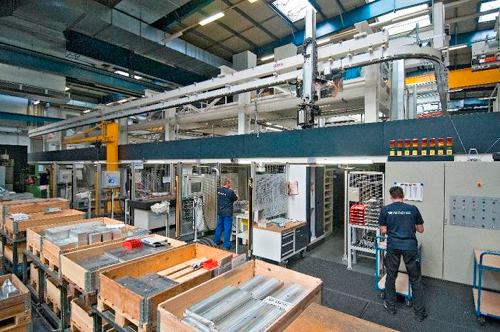
Series production of small parts: using concatenated Makino machining centers, each of which features separate set-up stations, a pallet buffer, a metrological station and a handling system.
17 Large Machining Centers with 44 Spindles
In order to assure cost-efficient manufacturing despite small batch sizes and high flexibility, the company opts for complete machining: Varel machines many components in a single clamping configuration on one machine. There are also around 30 five-axis machining centers for small parts and 15 nine-axis turn-milling centers for rotation parts. Because the large-surfaced parts mostly have to be machined from two sides, they have to be turned at least once. For this purpose, there are 17 large machining centers with a total of 44 spindles.
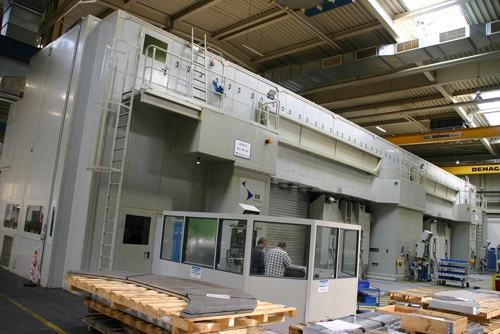
Take two: Integral components for aircraft are machined by the two concatenated DST high-speed machining centers with the aid of a parallel-kinematic machining head.
Parallel-Kinematics: High-Dynamic-Response Simultaneous Milling
These also include machines with parallel-kinematics. "I see it as an advantage that with the tripod machines we can run high-dynamic-response simultaneous five-axis milling", says Lange. "We can exploit this advantage with the very complex large aluminum components, where the ribs, for example, are aligned on 5 axes." Everyday machining in Varel, for example, includes five-axis, simultaneous rough milling with feed velocities of 20 to 25 meters per minute. To quote Lange: "For pocket corners, we have to alter the angular position with a slightly angled rib. Conventional fork heads can manage this only with extreme swiveling movements, whereas parallel-kinematics does this significantly faster and more elegantly."
Cutting Degree of Over 90 Per Cent
This work is performed on two concatenated high-speed machining centers from Dörries Scharmann Technologie GmbH (DST) in Mönchengladbach, on which integral aircraft components on pallets with a length of 7.8 meters are machined with the aid of the Sprint Z3 parallel-kinematic machining head. Milling is performed from the solid block, from contoured blanks plain-milled and predrilled with a cutting degree of more than 90 per cent. The machine operates using a 75-kilowatt spindle with a maximum speed of 24,000 revolutions per minute. The mostly three-edged tools generate 1,000 chips per second. The material removal rate is approximately five liters per minute. The useful lifetime of the tools is around ten hours for aluminum.
The largest machining center also comes from DST: this customized machine, however, is fitted not with a tripod, but with a conventional machining head. Behind two pallet folding tables in each case is a 40-ton travelling column with two spindles arranged horizontally above one another. Instead of linear technology, rack-and-pinion drives are used. "This twin-spindle machines handles HPC milling of large integral aluminum components", explains Mangels. "An HPC 5-axis machining center with two spindles arranged horizontally one above the other is, by the way, a rarity worldwide. To enable us to manufacture our small batch sizes cost-efficiently, we opt for in-process tool set-up here as well."
Varel could theoretically mill components up to 22 meters in length and 4.5 meter in width from a solid block. The requisite tools are created in-house. The facility in Varel has always developed its most important tools itself, which are then actually produced externally. Developing tools is a complicated job, since it involves altering and optimizing a good 20 to 30 parameters. "We consume about 500 tools a day, by the way", says the Head of Technology and Tooling. "My department supplies the production shop from a high-bay warehouse with 8,000 different tool elements, from which 12,000 complete tools are created." One highlight: compared to the Airbus A330, the proportion of titanium in the A350 rises from 5.0 to 14 per cent by weight. And then with the door frames, for instance, there are large titanium components that have to be milled. "We are manufacturing these parts for the first aircraft to be made from forged blanks", explains the expert. "We have developed solid carbide milling tools for the metal-cutting work, which have trebled the material removal rate in comparison to the previous tool."

Digital Factory: Debut for RFID Chip
Varel is also involved in a joint project called "Agilita - Agile Production Logistics and Transport Systems" headed by the Institute for Production Technology and Machine Tools (IFW) at Leibniz University in Hanover, Germany under whose aegis large-component manufacture is being imaged as a digital factory. Agilita consists of four individual building blocks. "What can be put into practice more or less immediately is data transmission using "Radio Frequency Identification or RFID", with the aid of which we will then know in the control center where the orders are currently located", says the Head of Investment and Plant Planning. "Because aluminum and titanium shield data traffic, we're currently developing concepts for affixing RFID stickers or chips." The first components featuring an RFID chip are already in use. The second step involves developing a system that functions on lean management principles for client-referenced production control. The focus here is on simulating production sequences online.
EMO 2011: Getting the Big Picture
The experts from Varel will also be getting plenty of relevant ideas at the EMO Hannover 2011. "We are very keen to use the EMO for getting the big picture beyond the confines of our own sector", said Mangels.
Want more information? Click below.