How Subaru Fixed Assembly Line Stoppages Using High Strength Color Coded Tools
Subaru Indiana Automotive resolved assembly line stoppages and tool identification errors by replacing cracking 3D-printed ABS jigs with durable, color-coded placement jigs made from Markforged Onyx GF, a high-strength, glass-filled nylon. This material upgrade endured rigorous factory conditions, enabling operators to consistently select the correct specialized tools on the first pass and maintain uninterrupted production.
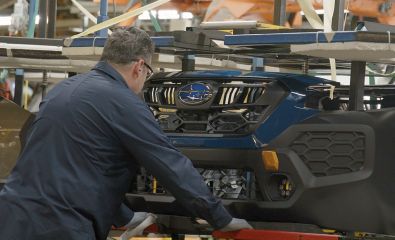
On a fast-moving automotive assembly line, seconds dictate the boundary between a highly profitable shift and an expensive logistical bottleneck. When multiple vehicle models travel down the exact same production track simultaneously, the mental load on assembly operators scales dramatically.
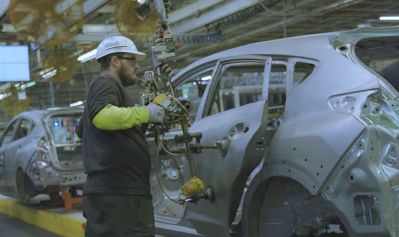
At Subaru Indiana Automotive, workers manage a fluid rotation of different variants back-to-back. On this line, specialized manufacturing tooling and jigs often differ by only a few minor millimeters from one vehicle model to the next. In such a high-velocity environment, expecting an operator to micromeasure a tool before applying it is an operational hazard. The correct tool must be instantly identifiable from a distance.
To bridge this cognitive gap, Subaru originally turned to visual color-coding systems to simplify tool selection. The factory floor logic was simple: give each vehicle model a designated color, and operators can match the tool to the incoming chassis without skipping a beat.
VIDEO: Keeping the Line Moving: Color-Coded Tooling at Subaru
To build these low-volume, customized parts quickly, the team initially utilized 3D-printed ABS. While the plastic easily provided the necessary color differentiation, it quickly faltered under the punishing physical demands of automotive manufacturing.
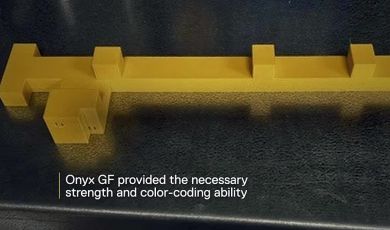
Tools on a high-throughput factory floor are grabbed, dropped, adjusted, and re-used hundreds of times during a single shift. Standard ABS simply lacked the structural integrity to endure this constant mechanical abuse, leading to fractured components and frequent replacements.
Seeking a material that offered both distinct visual identification and high durability, Subaru integrated Onyx GF into its existing Markforged manufacturing ecosystem. This glass-filled nylon material provided the structural ruggedness required to withstand the factory floor while maintaining the crisp color coding necessary for rapid identification.
The true value of this material upgrade quickly became evident in the painted bumper department. Subaru tracks every bumper moving through its paint shop via adhesive QR labels.
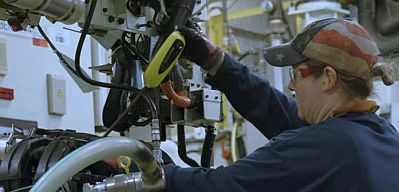
Originally, operators placed these tracking labels by hand. Because automotive bumpers lack built-in physical locating features, manual placement led to slight human variances. These minor inconsistencies prevented fixed overhead scanners from reading the tags reliably. When a scanner missed a label, the entire assembly line had to halt. Operators were forced to manually track the bumper, re-scan the tag, and reconcile the data system before restarting production.
To eliminate these costly stoppages, the engineering team designed a custom family of placement jigs that index directly off the external geometry of the bumper. These tools ensure every single QR label is applied within a strict one-tenth of a millimeter tolerance.
Because every car model and trim level requires a unique front and rear bumper geometry, the team produced specialized jigs for each variant. By printing these fixtures in distinct shades of Onyx GF, operators can immediately identify the precise jig needed for the incoming bumper trim, ensuring flawless scanner alignment without slowing down the line.
A similar operational victory occurred with the assembly jigs used for handling cam cap carriers. The manufacturing lab required a durable base component for a complex cradle jig. Previous iterations printed in standard ABS cracked under repeated load stresses.
By switching the design to Onyx GF Yellow, the component easily absorbed the daily physical strain where the previous plastic failed, while its bright yellow hue instantly signals its exact location on the shop floor. Ultimately, giving operators the ability to grab the right tool on the first pass keeps the assembly line moving seamlessly.
Want more information? Click below.
Rate this article
View our terms of use and privacy policy ::m::