Universal Robots Unveils Gen 7 Platform to Simplify Physical AI
Artificial intelligence has dominated industrial automation conversations in recent years, yet moving AI models out of a research lab and onto a physical shop floor remains a notoriously complex task. For most operations, the friction isn't the AI code itself -- it is the reality of trying to patch together external cameras, high-bandwidth sensors, heavy compute boxes, and a web of complex cabling onto traditional robotic arms.
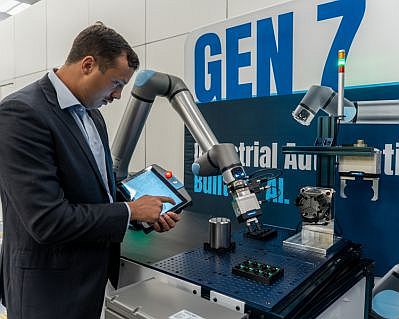
Universal Robots' Global Head of UR+ Ecosystem, Christopher Savoia, showcases the new SP7 Smart Panel on a UR17g-1300 robot at the launch of Gen 7 -- UR's 7th generation robotics platform at IMTS in Chicago.
Universal Robots tackles this integration bottleneck head-on with its seventh-generation platform, Gen 7. Rather than offering a simple incremental update, the platform delivers an end-to-end, out-of-the-box system upgrade designed specifically for physical AI deployment and seamless industrial connectivity.
The architecture is driven by the PolyScope X robot operating system and supported by three brand-new g-Series robot arms: the UR10g-1750, UR17g-1300, and UR18g-950. What makes these arms unique is the AI-ready tool flange. It routes data, power, and safety lines directly to the end of the arm, allowing cameras and edge-AI sensors to plug in without external cabling bundles that frequently snag or break. Paired with built-in force-torque sensing, impedance control, and Real-Time Data Exchange (RTDE), the g-Series arms gain a functional sense of touch, allowing them to handle dexterous manipulation and force-sensitive assembly tasks with extreme precision.
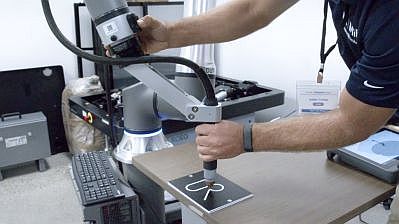
The SP7 Smart Panel brings programming to the point of work, letting operators engage PolyScope X Smart Skills and teach directly at the tool.
The underlying brains of the platform sit inside the redesigned CB7 Core controller. Universal Robots managed to pack 40% more compute power into a chassis that is 30% smaller than previous models. This boost allows the controller to process multi-network communication simultaneously, linking up directly with PLCs, HMIs, and vision systems without needing external network switches. For programmers, the system's integration with open APIs and ROS2 communication means they can run advanced edge-AI applications through external industrial PCs.
On the operator side, the upgrade focuses heavily on reducing shift fatigue and improving point-of-task interaction:
TP7 Core Teach Pendant: This unit is over 20% lighter than its predecessors, featuring multiple grip points, a full HD display, and a virtual joystick that makes tweaking code intuitive rather than rigid.
SP7 Smart Panel: Positioned directly at the tool flange, this interface features safety-compliant freedrive buttons and LED lights, letting operators manually position and teach the robot right at the workpiece. This is a massive time-saver for high-mix, low-volume manufacturing setups.
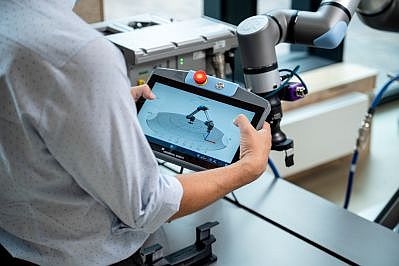
The new teach pendant is more than 20% lighter and more ergonomic than previous generations, has multiple grip positions, configurable smart buttons, and a full HD display, plus a new virtual joystick.
Crucially, the entire ecosystem meets modern compliance demands right out of the gate. The architecture holds a PLd, Category 3 safety certification, while the software pipeline is built under strict IEC 62443-4-1 cybersecurity development standards. By solving the underlying hardware and network complexities of physical AI, Gen 7 provides manufacturers with a predictable, secure sandbox to scale advanced automation.
Want more information? Click below.
Rate this article
View our terms of use and privacy policy ::m::