The Four-Billion-Dollar Manufacturing Boom Proved Itself Real at IMTS 2026

The bustling aisles of IMTS 2026 felt less like a standard trade show and more like a live-action response to a massive industry realignment. While headlines frequently focus on the simple metric of high attendance, the true story of this year's event lies in the data -- specifically, how the historic foot traffic in Chicago directly validates recent, unprecedented spikes in machine tool and cutting tool market reports.
The event drew 91,295 registrants, including 14,447 students and representatives from all 50 states, Washington, D.C., Puerto Rico, and 123 countries -- along with 1,788 exhibiting companies. But the defining metric was the record-breaking floor-density ratio, which climbed from an already impressive 1.42 at opening to an all-time peak of 1.65. This meant 165 buyers and peers were on the floor for every 100 exhibitor personnel.
This highly concentrated buying authority aligns perfectly with the explosive data from the U.S. Manufacturing Technology Orders (USMTO) report. In July 2026, new orders for metalworking machinery hit $605.8 million, marking only the second time since 1998 that orders exceeded half a billion dollars for five consecutive months. Year-to-date orders reached $4.03 billion -- a staggering 37.1% increase over the same period in 2025.

However, looking beneath the surface reveals that this isn't just a story of shops buying more machines; it is a story of shops buying smarter machines. While the total order value surged by over a third, actual unit volumes only rose by 13%. This divergence is driven primarily by an intense demand for high-end automation, software, and advanced integration. Driven by reshoring, supply chain regionalization, and defense needs, manufacturers are opting for highly sophisticated, automated cells to maximize output amid ongoing labor constraints.
This high utilization rate is further corroborated by the latest Cutting Tool Market Report. Cutting tool shipments -- a reliable, real-time barometer for actual shop-floor production -- hit a record $278.1 million in July 2026, a 29% jump over July 2025. This record performance represents the highest monthly total in the report's history. Because cutting tools are consumable items, these numbers prove that shops aren't just buying equipment to sit idle; they are aggressively cutting metal to work through heavy backlogs.
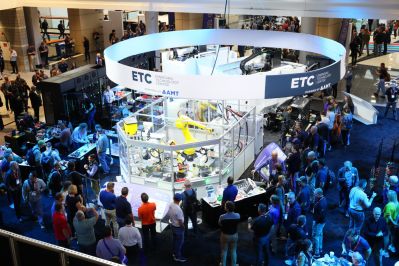
Yet, this booming environment is not without its friction. The record cutting tool figures are partially inflated by supply chain pain points, notably a double-digit spike in user costs driven by a global carbide crisis. This economic reality directly influenced attendee behavior at IMTS. Rather than just browsing, buyers actively sought out strategic alternatives -- such as modular tooling and replaceable carbide heads -- to mitigate soaring material costs.
Ultimately, IMTS 2026 served as a physical manifestation of a polarized, high-tech manufacturing boom. While legacy sectors like automotive face stagnation, industries like defense, aerospace, and high-tech are driving historic investments. The extraordinary energy on the show floor was the sound of an industry aggressively scaling up, weaponizing automation, and restructuring supply chains to secure a resilient domestic footprint.
"What differentiated IMTS 2026 was the strong focus on how manufacturing technology and investment are renewing America's industrial capability and strengthening the U.S. economy, industrial base, and national defense," said Douglas K. Woods, president of AMT -- The Association For Manufacturing Technology, which owns and produces IMTS. "Manufacturers and job shops came to find technologies that could immediately increase productivity, and they were joined by investors, Fortune 500 and Silicon Valley companies, government agencies, universities, and a new generation drawn to industrial AI, automation, space, and advanced manufacturing."
Want more information? Click below.
Rate this article
View our terms of use and privacy policy ::m::