The Shift to Action: How Epicor is Redefining ERP with Agentic AI
Epicor has introduced an agentic AI stack, including the Epicor Lux governance framework and Prism Agent Foundry, designed to transform ERP systems into active, automated tools for manufacturers. This framework enables the deployment of specialized AI agents that securely execute, rather than just report on, complex, high-value workflows within the ERP.
For decades, Enterprise Resource Planning (ERP) software has served as the operational backbone of the global "make, move, and sell" economy. It was designed to do one job exceptionally well: act as a system of record. It stored inventory counts, tracked financial transactions, and housed supply chain logs.

However, manufacturers, distributors, and logistics providers have long faced a fundamental bottleneck. While traditional ERP systems are excellent at storing data, they require human operators to do the heavy lifting of extracting, analyzing, and acting upon that data.
At Epicor Insights 2026, global enterprise software leader Epicor announced a massive paradigm shift. By introducing a sophisticated, enterprise-grade agentic AI stack and expanding its AI-driven cloud migration framework, Epicor is actively evolving the ERP from a passive system of record into an active system of outcomes.
Instead of simply telling managers what happened yesterday, the modern ERP is now capable of executing complex business decisions, accelerating cloud deployments to record speeds, and automating deep supply chain workflows. Here is a look at how Epicor is utilizing agentic AI to reshape the industrial landscape.
From Insight to Autonomous Action: The Epicor Prism Agentic Stack
The headline of Epicor's latest technological leap is the introduction of a structured, unified agentic AI stack built directly within Epicor Prism. Prism represents a network of vertical AI agents engineered to execute work directly inside core ERP environments.

General-purpose AI tools often struggle in heavy industrial environments because they lack operational context and rigorous security controls. Epicor's new stack solves this by providing a robust, three-tiered framework that spans planning, creation, and execution.
1. Epicor Lux: The Governance Framework
At the foundation of this ecosystem sits Epicor Lux, an advanced agentic design system. Lux goes far beyond a traditional user interface. It acts as the ultimate control framework, ensuring that every autonomous agent looks, feels, and behaves like a trusted enterprise product.
Importantly, Lux enforces strict security standards, data privacy, and governance. It provides a transparent interface that helps human operators understand an agent's context, confidence level, and potential consequences before an action is finalized, keeping "humans in the loop" for critical choices.
2. Epicor Prism Agent Foundry: Empowering Custom Innovation
Because no two manufacturing facilities or supply chains operate exactly alike, Epicor launched the Prism Agent Foundry. This guided, self-service workspace allows customers and partners to build and customize their own vertical-specific AI agents.

Using their unique operational data, businesses can design custom agents tailored to highly specific corporate goals. The Foundry allows organizations to orchestrate complex workflows and visibility tools safely within Epicor's enterprise governance guardrails, fostering an open yet secure AI ecosystem.
3. Purpose-Built Prism Agents: Tackling the Heavy Lifting
Alongside custom creation tools, Epicor rolled out an extensive lineup of pre-built, industry-specific Prism agents designed for immediate operational impact. Rather than dealing with generic prompts, these agents handle time-intensive, decision-critical workflows:
- MRP Log Agent: Deeply analyzes Material Requirements Planning (MRP) output logs to explain exactly why specific production and purchasing recommendations were made.
- Freight Spend Agent: Cross-references ERP data with shipping documentation to automatically identify carrier discrepancies, reconcile financial variances, and plug freight budget leaks.
- Smart Data Capture Agent: Automatically extracts and validates complex financial and compliance documents across accounts payable workflows.
- Specialized Workflow Tools: Includes the EDI Agent for investigating electronic data interchange transactions, the Prophet 21 Business Rules Agent for updating platform logic using natural language, and the Reasoning Agent for synthesizing messy ERP context into immediate action.
Operational Proof: Real-World Efficiency Gains
This agentic framework isn't just a conceptual blueprint; it is already operating at scale in high-volume production environments. Epicor's Prism Knowledge Agent currently processes more than 70,000 requests per month across applications like Kinetic, Prophet 21, and Propello, helping users complete daily operational tasks with unprecedented efficiency.
VIDEO: Epicor Prism: Revolutionizing Supply Chain with AI-Driven ERP
According to the company, Epicor maintains the largest opt-in ERP dataset in the industry, powering inventory and transactions across roughly 40 percent of the $54 billion U.S. independent wholesale automotive aftermarket. This massive data scale injects deep contextual insight into Epicor's AI models, allowing the system to recognize broader supply chain patterns and support highly informed operational decisions.
The real-world benefits translate directly to the bottom line. For instance, Daniel Epler, Chief Financial Officer at Tuffaloy Products, Inc., noted that Prism delivers approximately 85% faster shipment tracking. It accomplishes this by collapsing tedious, multi-system lookups into a single view, allowing customer service teams to provide near-instant responses and boost buyer confidence.
Going Headless: The Future of Enterprise Architecture
As AI interfaces rapidly evolve, Epicor is also future-proofing the core architecture of enterprise software by advancing "headless" ERP capabilities.
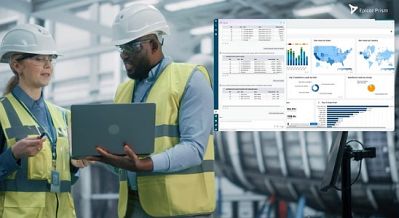
By delivering API-first ERP services completely independent of traditional, screen-based user interfaces, Epicor allows AI agents -- including Prism and external, customer-preferred Large Language Model (LLM) platforms -- to securely interact with core business systems.
Utilizing emerging interoperability standards like the Model Context Protocol (MCP), these agents can execute transactions, run calculations, and modify workflows directly. This headless approach allows manufacturers to adopt cutting-edge AI technologies and conversational interfaces without having to completely rip and replace their foundational ERP software.
Accelerating the Cloud Journey: The Expanded Ascend Program
An enterprise cannot leverage advanced, agentic AI if it remains trapped on rigid, legacy, on-premises servers. To truly capitalize on cognitive ERP capabilities, businesses must transition to the cloud. However, traditional ERP migrations are notoriously slow, complex, and disruptive to daily floor operations.
To eliminate this friction, Epicor announced a major expansion of Ascend with Epicor. This program combines a proven methodology, strategic business planning, expert consulting, and advanced AI tooling to fast-track the cloud migration journey.
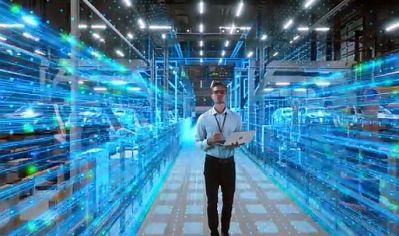
Originally designed purely for existing customers moving to the cloud, the expanded Ascend program now aggressively targets three core operational scenarios:
- New customers migrating away from legacy, non-Epicor ERP platforms.
- Existing customers transitioning from on-premises setups to secure cloud environments.
- Growing organizations rapidly integrating newly acquired business units or subsidiary brands.
Using AI to Eradicate Manual Discovery Work
Ascend utilizes specialized AI algorithms to audit a customer's active environment, extract and organize complex datasets, and automatically generate a highly optimized migration plan before the implementation phase even begins. This removes the slow, manual discovery work that historically bogs down IT projects. By surfacing potential data formatting risks and architectural mismatches early, project teams can resolve issues long before they impact go-live timelines.
Instead of a basic "lift-and-shift" data transfer, Ascend applies an intelligent, structured approach to data extraction. The AI ensures all historical information is cleaned, structured, and fully usable the moment it lands in the new cloud environment. For manufacturers, this means drastically less time spent massaging data and more time operating on a high-performance platform.
From Months to Weeks in High-Stakes Acquisitions
The true power of this AI-driven migration framework becomes clear during time-sensitive corporate events, such as mergers and acquisitions. In these scenarios, companies must integrate disparate systems immediately to maintain manufacturing continuity.
Initial deployments of the expanded Ascend program have demonstrated a 40 percent reduction in traditional implementation timelines. In some high-stakes scenarios, the results are even more dramatic.
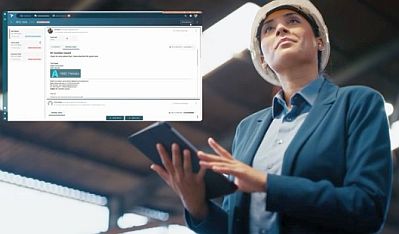
When Cornell Pump Company faced a complex corporate acquisition, they had days -- not months -- to keep their operations running smoothly. According to IT Manager Todd Arntson, the company successfully deployed Epicor Kinetic in just two weeks without losing a single piece of historical data from their previous ERP platform, NetSuite. Epicor's AI migration tools minimized operational disruption and turned a high-risk transition into a confident, rapid go-live.
Grounded in Supply Chain Reality
The ultimate goal for Epicor is a cognitive, predictive, network-level supply chain. By utilizing opt-in, anonymized data across a global community of users, the ERP will soon be able to anticipate shortages, automatically reroute logistics, and dynamically rebalance production schedules before issues ripple through the economy.
As Vaibhav Vohra, President and Chief Product and Technology Officer at Epicor, summarizes:
"AI only succeeds in production when it's grounded in reality. That requires deep industry knowledge, a trusted ERP data model, and enterprise-grade security. All of which are capabilities that uniquely position Epicor to bring AI into real supply chain execution at scale."
By combining autonomous, workflow-executing AI agents with smart migration tools that bring companies into the cloud in record time, Epicor is ensuring that manufacturers don't just survive the next industrial revolution -- they actively drive it.
Want more information? Click below.
Rate this article
View our terms of use and privacy policy ::m::