The Industrial Reality Check: Why Factory Success Depends on Execution, Not Ambition
Execution means improving data visibility and equipment reliability incrementally, not waiting for a complete digital overhaul that may never come, writes Rodriques Johnpeter -- Global Industry Segment Manager at the HARTING Technology Group.
Manufacturers today are navigating a perfect storm of supply chain disruptions, escalating costs and the urgent need to weave automation and AI into aging facilities without grinding production to a halt. The vast majority of industrial plants -- estimated at over 70% -- operate as brownfields, burdened by legacy equipment, fragmented data silos and razor-thin tolerances for downtime that make sweeping overhauls impractical.
Bold ambitions for digital transformation often falter here, assuming greenfield conditions that rarely exist, leaving execution as the true dividing line between leaders and laggards.
However, success stories on the factory floor prove it's possible to deliver real results, and leading manufacturers are prioritizing technologies such as digital twins for supply chains and plug-and-play components that integrate seamlessly, yielding measurable ROI through targeted gains in uptime and efficiency, often without major disruptions.
By focusing on value first, building interoperability from day one and favoring modular, scalable systems, they're turning operational pain points into competitive edges. It's no longer about who has the boldest Industry 4.0 roadmap -- it's about who can make real progress with the factory they already have.
Why execution, not ambition, is the key differentiator
Many manufacturers operate with plants that are decades old, and are stitched together from a patchwork of equipment, control systems and data silos that resist easy change. These legacy setups demand near-constant uptime, leaving little room for the disruptive overhauls often envisioned in transformation roadmaps.
The greenfield fallacy trips up too many strategies -- assuming blank-slate conditions with modern sensors and seamless connectivity that rarely exist in reality.
Execution-focused leaders sidestep this by planning incremental, interoperable upgrades tied directly to immediate business needs, like cutting downtime by 10% or boosting throughput without halting lines. Execution means improving data visibility and equipment reliability incrementally, not waiting for a complete digital overhaul that may never come. This more pragmatic path turns constraints into advantages, proving that real progress comes from what's possible now, not what's dreamed on paper.
Common pitfalls when adopting automation and AI
Integrating new automation and AI into legacy operations hits interoperability roadblocks first.
Many modern systems struggle to communicate with older PLCs, sensors and protocols, creating integration gaps that stall deployment. Sixty-five percent of manufacturers cite connectivity and interoperability as top barriers to scaling AI initiatives, often requiring costly custom middleware or full hardware swaps. Data readiness compounds the issue as factories generate massive volumes of data, yet it arrives fragmented, unstructured or trapped in proprietary formats, making it unusable for AI without extensive cleaning. Accessing reliable data without production downtime is especially challenging, with 68% of leaders ranking data silos as their primary hurdle in unified access. This leads to "garbage in, garbage out" scenarios where AI models underperform on real-world inputs.

Cultural and skills gaps additionally seal many failures.
For instance, OT teams prioritize uptime over experimentation, while IT pushes cloud-first solutions that don't fit edge realities. Without cross-functional ownership, initiatives suffer proof-of-concept paralysis and stall out. Workforce upskilling lags too, leaving gaps in interpreting AI insights or troubleshooting hybrid systems. These human factors explain why up to 80% of industrial AI projects fail to scale beyond pilots.
Technologies and practices driving real ROI
Leading manufacturers are cutting through brownfield constraints by zeroing in on technologies that deliver measurable returns without requiring full rip-and-replace overhauls.
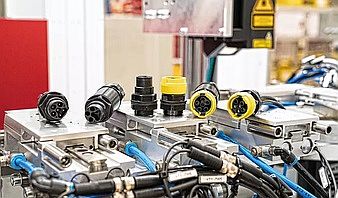
Digital twins (virtual replicas of supply chains or production lines) stand out for simulating changes and enabling predictive maintenance before they hit the factory floor, often yielding 20-30% cost reductions through optimized operations. Plug-and-play infrastructure takes this one concept further, with modular, standardized connectors that snap into legacy setups, allowing incremental upgrades like new sensors or robots with minimal wiring rework and downtime.
Success in these scenarios hinges on a value-first mindset where technology follows the business problem, not the reverse. Whether targeting downtime reduction or energy efficiency, projects shine when they map clearly to outcomes -- think faster line changeovers from interoperable components or sustained uptime via scalable digital models. Leaders bake in interoperability from day one using open standards, sidestepping vendor lock-in while ensuring future-proof scalability that keeps capex predictable.
The human element is the practice that drives real execution with evolving systems. Plant teams gain real-time data access, targeted training and collaborative tools to own these hybrid systems, turning potential resistance into ownership. Modernization doesn't have to mean replacing what works, it can mean connecting what you already have in smarter ways.
The new industrial playbook
Ambitious digital roadmaps abound, but as we've seen, they often falter against the brownfield reality of legacy equipment, data silos and zero-tolerance downtime. The differentiator isn't vision; it's disciplined implementation that sidesteps interoperability pitfalls, ensures data readiness and prioritizes proven technologies that deliver tangible ROI in uptime and efficiency.
The future of manufacturing won't be built overnight. Rather, it will be executed one interoperable connection at a time.
Want more information? Click below.
Rate this article
View our terms of use and privacy policy ::m::