September 2008 Edition
machine solutions
Rebuilds may make sense
When money’s tight, buying new equipment isn’t the only option
By Todd M. Suppes
 Every rebuild is unique, but generally costs for full mechanical rebuilds are significantly less than a similarly sized and optioned new machine.
Rebuild or buy new? It’s a question that grows all the more difficult to answer when production requirements change or new part types are introduced into the workplace environment. As more and more manufacturers find their budgets not allowing for the purchase of new machines — and when current machines suddenly grow less capable of meeting new tolerances and cycle time requirements — some are assessing the value of rebuilding their existing machine tool assets.
Rebuilding can be a reliable and cost-effective answer to these challenges. And if it’s going to be done, one should use an OEM-certified machining center rebuilder. Major benefits include the familiarity of maintenance and operator personnel with the equipment, reuse of durable tooling, and using existing footings and building service drops. These are large financial incentives to reutilizing existing machines.
While it’s true that today’s machining centers can be more productive than those of 15 years ago, most machining centers are not exponentially faster than those of three, five, and in many cases, 10 years ago. While the gain in speeds, efficiencies, and ease of programming for linear guide way machines are worth noting, box-way construction machines have seen minimal increases in speed and overall machine efficiencies.
However, the durable construction of this type of equipment cannot be surpassed for aggressive machining or high-volume production requirements in steel or other ferrous materials. These machines or high-end linear way machine tools are often the best fit for rebuild or complete overhauls.
Many factors need to be considered in the rebuild vs. new decision: What portions of your current equipment are sound and what updates are available for those that aren’t? What standards or tolerances need to be taken into account for machine performance? What is the availability and timetable for repair/remanufacture/rebuild services versus delivery of new equipment? Who is doing the work and what warrantees are available?
Understand the terms
First, it is useful to have a general understanding of what the terms mean when considering upgrading current equipment or requesting proposals:
- Repair: Fix or replace whatever is broken to return the machining center to operation as quickly as possible.
- Schedule B: An evaluation of the machine tool that can be performed on the customer’s or the machine rebuilder’s shop floor. This evaluation identifies the areas of the machine requiring repair or replacement.
- Recondition: Bring existing machine elements back to original condition as close as possible or better. This may include partial geometric requalification of the base, column, or other components, as well as the partial or full rebuilding of various subassemblies.
- Retool: Involves the machine rebuilder providing newly designed or upgraded tooling, fixtures, and workholding systems for new part types or for increasing efficiencies on existing part types. This may require updates to hydraulic, pneumatic, or electrical control devices.
- Partial rebuild: Bringing the machine’s subassemblies and peripheral components back to original OEM mechanical tolerances and operating conditions.
- Complete remanufacture: This entails the complete teardown of the machine to its base and rebuilding or replacing mechanical, hydraulic, and pneumatic assemblies. It also includes repair or replacement of guarding, seals, wipers, or other barriers to critical machine components. Complete control retrofits or upgrades can also be performed at this time.
- Control Retrofit: Removal of existing control and drive mechanisms and replacing with updated components.
Health integrity report
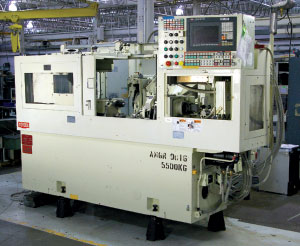 Rebuilding existing equipment can reap large economic benefits for those lacking funding for new equipment purchases.
Often, when a customer has a candidate machine for rebuilding, the most useful tool to consider is a machining center health integrity report, which can be performed on the customer’s shop floor or upon arrival of the machine tool at the facility.
This type of evaluation begins with making general observations of the machine tool’s overall condition and any current issues as reported by the shop maintenance department or operator personnel. This is then followed by a review of the machine’s statistical quality performance. Further assessments are then performed, such as machine geometry evaluations, ballbar inspections, X-Y-Z laser checks, spindle inspections, and in-depth overall assessments of the machine tool’s electrical and fluid power systems.
Due to this thorough inspection and the attendant teardowns and inclusive inspections, customers should be aware that evaluation fees are not
uncommon for such a service. Credible OEMs, however, use the information that such reports provide as a starting point for a comprehensive rebuild proposal and often credit the price or apportion thereof against the actual rebuild costs.
Who’s doing your rebuild work?
Pay attention to the level of service. Are all reports, timetables, parts lists, and prices clearly stated? Does the company have the experience, depth, and support to stand behind its work? Are you getting the best combination of engineering, experience, expertise, and service for your investment?
Every rebuild is unique, but generally costs for full mechanical rebuilds are significantly less than a similarly sized and optioned new machine. Rebuilding existing equipment can reap large economic benefits for those lacking funding for new equipment purchases. And selecting an OEM or OEM-certified rebuilder ensures parts and performance meet your and your customers’ expectations.
Toyoda Machinery
Todd M. Suppes is aftermarket sales manager for the Automotive Products Division of Toyoda Machinery USA.
What do you think?
Will the information in this article increase efficiency or save time, money, or effort? Let us know by e-mail from our website at
www.ToolingandProduction.com or e-mail the editor at
dseeds@nelsonpub.com.
editor's blogs

Off the Toolpath
EASTEC marks 30th show with spotlight on medical devices
The recession hasn’t stopped business, if the activity at the EASTEC Advanced Productivity Exposition is to judge. The show, in its 30th year, drew 570 exhibitors, down from 608 in 2008 and 650 in 2007. About 15,000 attendees pre-registered. Last year’s show tallied 14,000 attendees. The largest industrial tool trade show on the East Coast, EASTEC was held May19-21 in West Springfield, MA.
by Dennis Seeds, Editor-in-Chief
digital edition
On target
For a new generation of parts, automated centerless grinding fills the bill
The taper test
Prototype fixture finds the reason why vexing toolholder wear marks appear
Watchful eye keeps tabs on 575 machine tools
Aerospace supplier sees new productivity heights, lower costs
From 12 hrs to 25 mins
Giant steps for faster cavity hogging, square-offs follow re-tooling