September 2008 Edition
FDM
Possibilities abound with fused deposition modeling
BMW plant uses technology to build tools for assembly, testing
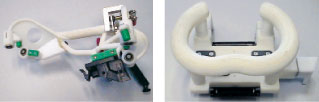 In the jigs and fixtures department at BMW AG, Regensberg, an FDM system is
used to rapid manufacture assembly tools such as these.
In the jigs and fixtures department at BMW AG, Regensberg, an FDM system is
used to rapid manufacture assembly tools such as these.
Like many other manufacturers, BMW makes use of rapid prototyping
to develop products — and at the BMW AG plant in Regensburg,
Germany, FDM (fused deposition modeling) continues to be an
important component in vehicle design prototyping.
But moving beyond prototyping, BMW is extending the application
of FDM to other areas and functions, including direct digital
manufacturing.
The plant’s department of jigs and fixtures uses FDM by Stratasys
Inc. of Eden Prairie, MN, to build hand tools for automobile
assembly and testing.
"BMW has determined that the FDM process can be an alternative to
the conventional metal-cutting manufacturing methods such as
milling, turning, and boring," says engineer Günter Schmid.
Schmid and fellow engineer Ulrich Eidenschink believe that the
financial advantages include cost reductions in engineering
documentation, warehousing, and manufacturing.
‘FDM is taking on increasing importance as an
alternative manufacturing method for components made in small
numbers.’
— Günter Schmid
For hand-held devices used on the assembly line, engineers have
discovered that there are even greater advantages that arise from
the design freedom that FDM offers. Capitalizing on the elimination
of constraints, Schmid and Eidenschink employ FDM to make
ergonomically designed assembly aids that perform better than
conventionally made tools.
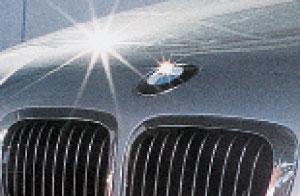 Thanks to a tool created for attaching bumper supports, this BMW exhibits
the classic look of the automobile.
Thanks to a tool created for attaching bumper supports, this BMW exhibits
the classic look of the automobile.
To improve productivity, worker comfort, ease-of-use, and process
repeatability, the plant uses FDM to enhance the ergonomics of its
hand-held assembly devices. The freedom of design allows engineers
to create configurations that improve handling, reduce weight, and
improve balance.
"The tool designs we create often cannot be matched
by machined or molded parts," says Schmid.
In one example, BMW reduced the weight of a device by 72 percent
with a sparse-fill build technique. Replacing the solid core with
internal ribs cut 1.3kg (2.9lbs) from the device.
"This may not seem like much, but when a worker uses the tool
hundreds of times in a shift, it makes a big difference," says
Schmid.
 Another
advantage of direct digital manufacturing is improved functionality.
Since the additive process can easily produce organic shapes that
sweep and flow, the tool designers can maximize performance while
improving ergonomic and handling characteristics.
Another
advantage of direct digital manufacturing is improved functionality.
Since the additive process can easily produce organic shapes that
sweep and flow, the tool designers can maximize performance while
improving ergonomic and handling characteristics.
"The layered FDM manufacturing process is well-suited for the
production of complex bodies that, when using conventional
metal-cutting processes, would be very difficult and costly to
produce," says Eidenschink.
An example is a tool created for attaching bumper supports, which
features a convoluted tube that bends around obstructions and places
fixturing magnets exactly where needed.
The jigs and fixtures department has developed a simple flow
chart to determine when FDM is a fitting option. The criteria are
temperature, chemical exposure, precision, and mechanical load. With
FDM’s ABS material, which the engineers find comparable to polyamide
(PA 6), many tools for vehicle assembly satisfy the criteria. For
those that do, designers can create devices that capitalize on all
the advantages of the additive process.
Stratasys
Inc.
What do you think?
Will the information in this article increase efficiency or
save time, money, or effort? Let us know by e-mail from our website at
www.ToolingandProduction.com or e-mail the editor at
dseeds@nelsonpub.com.
editor's blogs

Off the Toolpath
EASTEC marks 30th show with spotlight on medical devices
The recession hasn’t stopped business, if the activity at the EASTEC Advanced Productivity Exposition is to judge. The show, in its 30th year, drew 570 exhibitors, down from 608 in 2008 and 650 in 2007. About 15,000 attendees pre-registered. Last year’s show tallied 14,000 attendees. The largest industrial tool trade show on the East Coast, EASTEC was held May19-21 in West Springfield, MA.
by Dennis Seeds, Editor-in-Chief
digital edition
On target
For a new generation of parts, automated centerless grinding fills the bill
The taper test
Prototype fixture finds the reason why vexing toolholder wear marks appear
Watchful eye keeps tabs on 575 machine tools
Aerospace supplier sees new productivity heights, lower costs
From 12 hrs to 25 mins
Giant steps for faster cavity hogging, square-offs follow re-tooling