September 2008 Edition
simulation software
No more trial and error
CAD-embedded CFD helps save months in automotive valve design
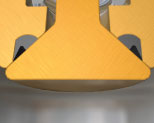 The Ventrex CO2 valve needs to operate at pressures seven to 10 times higher
than previous generation systems.
The Ventrex CO2 valve needs to operate at pressures seven to 10 times higher
than previous generation systems.
Ventrex Automotive GmbH, of Graz, Austria, saved four
months in the design of an automotive valve by taking advantage of Flomeric’s
EFD.V5 for Dassault Systèmes CATIA V5-embedded computational fluid dynamics
(CFD) simulation software.
"In the past, we would have had to build and test at least 50
valves in order to get the design right," says Peter Pfaffenwimmer,
project manager for Ventrex Automotive GmbH.
"CAD-embedded CFD made it possible to determine simulation
results nearly as fast as we changed the design," says Daniel
Gaisbacher, also a project manager for Ventrex. "The result is that
we were able to improve the flow rate of our new valve by 15 percent
while eliminating about 50 prototypes and reducing time to market by
four months."
Automotive air conditioning systems are beginning to use CO2
as the refrigerant because it does not damage the ozone layer and
also has a low impact on global warming. But CO2-based
systems need to operate at pressures seven to 10 times higher than
previous generation systems, and this requires redesign of many
components.
‘By using CFD software that is embedded into our CAD
software, we could evaluate the performance of each new design
iteration almost as fast as we could conceive it.’ — Daniel
Gaisbacher
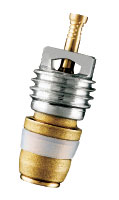 This view shows a part of an a/c-line with Ventrex’s valve body and the
assembled valve core.
This view shows a part of an a/c-line with Ventrex’s valve body and the
assembled valve core.
Among the components most affected by the change is the valves
used to evacuate and charge the system. Most important, the pressure
drops seen in existing valves are too high to enable the required
flow rates. But reducing the pressure drop of valves is challenging
because of the complexity of internal flow passages caused by the
presence of components used to open and close the valve.
In the past, engineers would make design changes based on
educated guesses. For each design change they had to build and test
a prototype of the valve. This process was time-consuming and
expensive, and the test results did not provide diagnostic
information that would help engineers determine whether or not the
design change had the intended effect.
CFD makes it possible to build a software prototype of the valve
that can be solved to determine the pressure drop of any particular
design iteration without having to build a prototype. A drawback to
its use has been that traditional CFD codes require the user to
understand deeply the computational aspects of fluid dynamics in
order to be certain of obtaining accurate results.
But EFD.V5 eases the simulation process by extending
CATIA V5 functionality to include fluid flow and heat
transfer simulation within a single-user environment.
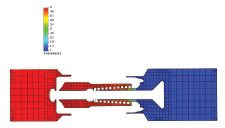 An embedded computational fluid dynamics (CFD) simulation tool helped
Ventrex to improve the flow rate of its new valve by 15 percent.
An embedded computational fluid dynamics (CFD) simulation tool helped
Ventrex to improve the flow rate of its new valve by 15 percent.
"We selected EFD.V5 because it simplifies the process of
performing fluid flow analysis to the point where it can be
accomplished by any engineer," Gaisbacher says. "By using CFD
software that is embedded into our CAD software, we could evaluate
the performance of each new design iteration almost as fast as we
could conceive it. This made it possible to quickly improve the
performance of the design."
He says the company reduced pressure drop to the point that flow
rate improved by about 15 percent in the
final design at any given pressure.
"We reduced the number of prototypes that were required during
the design process by about 50, which saved a considerable amount of
money, but most importantly let us bring the product to market
faster," Gaisbacher says.
Flomerics Group PLC
Dassault Systèmes
What do you think?
Will the information in this article increase efficiency or
save time, money, or effort? Let us know by e-mail from our website at
www.ToolingandProduction.com or e-mail the editor at
dseeds@nelsonpub.com.
editor's blogs

Off the Toolpath
EASTEC marks 30th show with spotlight on medical devices
The recession hasn’t stopped business, if the activity at the EASTEC Advanced Productivity Exposition is to judge. The show, in its 30th year, drew 570 exhibitors, down from 608 in 2008 and 650 in 2007. About 15,000 attendees pre-registered. Last year’s show tallied 14,000 attendees. The largest industrial tool trade show on the East Coast, EASTEC was held May19-21 in West Springfield, MA.
by Dennis Seeds, Editor-in-Chief
digital edition
On target
For a new generation of parts, automated centerless grinding fills the bill
The taper test
Prototype fixture finds the reason why vexing toolholder wear marks appear
Watchful eye keeps tabs on 575 machine tools
Aerospace supplier sees new productivity heights, lower costs
From 12 hrs to 25 mins
Giant steps for faster cavity hogging, square-offs follow re-tooling