September 2008 Edition
turning solutions
Let’s be Direct
System brings speed and accuracy to cut cycle time by 30 percent
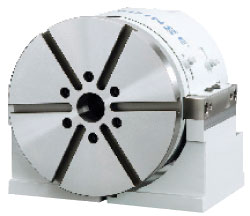 Aero Precision Machine runs a Hardinge Direct-Drive Rotary System on a
Bridgeport vertical machining center to produce close tolerance parts for
the pharmaceutical industry’s inspection process.
Aero Precision Machine runs a Hardinge Direct-Drive Rotary System on a
Bridgeport vertical machining center to produce close tolerance parts for
the pharmaceutical industry’s inspection process.
Mike Langlois, owner of Aero Precision Machine in Julian, N.C.,
owned and operated his first lathe when he was 13 years old. He was
making his own model airplane parts to keep the motors running at
higher horsepower and rpm, and even selling them internationally to
other model airplane enthusiasts. He eventually ended up getting a
pilot’s license and buying an early model Beechcraft.
It was in the early 1990s when Langlois decided to set up a shop
to specialize in close tolerance aerospace parts. A friend from
Pennsylvania, Henry Nelson, recommended that he consider a colleted-spindle
turning machine and suggested that he look at Hardinge lathes.
Through research, Langlois found that when gripping the part
within the spindle closest to the spindle bearings, one can achieve
a better concentricity, better surface finish, and therefore put out
a higher precision part.
Langlois purchased a used Hardinge HNC lathe and began making
aircraft landing gear bushings. His wife and two sons joined the
business in 1996, which has now grown in the number of employees and
size, and is still growing. Aero Precision Machine now produces
parts for the aerospace, defense, and pharmaceutical industries.
The company handles mostly smaller parts in diameters up to 10
inches, but their sweet spot is the ¾ to 2-1/2" range. Over the
years, the company has built its entire turning capabilities using
Hardinge collet-ready spindle lathes for high-precision turning,
including a Quest 10/65 Super-Precision HydroGlide turning center.
Accuracy is the word
 Standing left-to-right: Frank Bock, Hardinge sales engineer; David Everage,
CNC machinist; and Steven Langlois, CNC machinist and programmer.
Standing left-to-right: Frank Bock, Hardinge sales engineer; David Everage,
CNC machinist; and Steven Langlois, CNC machinist and programmer.
"It’s all about accuracy," says Langlois. "We made the decision
to be a collet shop. Down here, that is kind of a rarity. Everybody
wants an 8-inch chuck machine.
"Our parts are often more fragile, have a thin wall, or a close
tolerance," he says. "Typically with aircraft parts, such as landing
gear bushings, we need to hold a 0.0002" to 0.0003" tolerance on the
OD and ID. Early on, we decided to go with the collet-ready
spindles, and I have never regretted that decision.
"For us, the chuck is the workholding device of last resort.
Using a collet, I can spin the part up faster, turn it at high rpm,
and the concentricity and the surface finish are better. Plus, the
setup is quicker."
It was one of the features that sold Langlois on Hardinge’s
Direct-Drive Rotary System.
"One of the advantages of the indexer is the collet-ready spindle
that lets us use our existing supply of collet type workholding,"
Langlois says. "We didn’t have to buy anything. We use mostly 16C
collets in this shop and the DD300 rotary system uses 16C collets."
The DD300 combines high levels of torque, speed, and accuracy. It
doesn’t have any gears, so there is no wear over time.
‘It’s all about accuracy. We made the decision to be a
collet shop. Down here, that is kind of a rarity. Everybody
wants an 8-inch chuck machine. Our parts are often more fragile,
have a thin wall, or a close tolerance.
— Mike Langlois
The wheel-style part, made from 2024 aluminum, is used in the
pharmaceutical inspection process. The customer’s part to be
inspected is located against each of the six drilled surfaces.
Aero Precision Machine turns the outside diameters and cuts it
off on the Hardinge turning lathes. Then the part is slipped on a
Sure-Grip expanding collet in the Hardinge DD300 Rotary System for
machining on a Bridgeport XR1000.
The next step is to ball mill the 12 outside shapes, center drill
the part and then drill the six ports true to the center position.
Finally, it’s off the center for a counterbore, drill and tap, then
slit with a slitting saw and finish up with an end mill.
Shorter cycle times
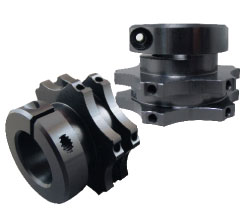 “We see a 30 percent reduction in part cycle time due to the ultra-fast
positioning speed of 1,500 degrees per second, and a cutting speed of 600
degrees per second of the Hardinge DD300 direct-drive system. We are also
seeing more consistent repeatability,†says Mike Langlois, owner of Aero
Precision Machine.
“We see a 30 percent reduction in part cycle time due to the ultra-fast
positioning speed of 1,500 degrees per second, and a cutting speed of 600
degrees per second of the Hardinge DD300 direct-drive system. We are also
seeing more consistent repeatability,†says Mike Langlois, owner of Aero
Precision Machine.
"We used to run this part on a different brand fifth-axis indexer
until we purchased the Hardinge direct-drive rotary system," says
Langlois. "We see a 30 percent reduction in part cycle time due to
the ultra-fast positioning speed of 1,500 degrees per second, and a
cutting speed of 600 degrees per second of the DD300 direct-drive
system. We are also seeing more consistent repeatability.
"When we used the other-brand indexer to make the parts, we had
to make offset changes on the machine tool nearly every other part
to keep the part within tolerance," he adds. "The part’s pick-up
contours have to be held to within 0.001" on diameter and at a 60
arc-sec angular position."
The combination of the Bridgeport XR1000 and Hardinge DD300
rotary system made holding both tolerances simple. The XR1000 has
thermal compensation on the Z axis, so holding diameters on parts
being processed on a DD300 requires far fewer offset changes.
Precision jobs in the pharmaceutical industry are based on
supplier performance, Langlois says. There’s no margin for an
imperfect part.
 "This
means that we have to establish a reputation for 100 percent quality
and consistency," Langlois says. "Every part has to be individually
inspected. We feel confident that Hardinge machines and their
technology have helped us to maintain our reputation as a high
precision shop."
"This
means that we have to establish a reputation for 100 percent quality
and consistency," Langlois says. "Every part has to be individually
inspected. We feel confident that Hardinge machines and their
technology have helped us to maintain our reputation as a high
precision shop."
Which is why Langlois’ direct-drive rotary system has been such a
boon for his company.
"It has more speed and more accuracy than anything I’ve seen on
the market," says Langlois. "In this era of multitasking machines,
and especially for jobs that require a heavy-duty milling spindle,
the DD300 could be the device that opens up the frontier of turning
on a mill."
Hardinge
What do you think?
Will the information in this article increase efficiency or
save time, money, or effort? Let us know by e-mail from our website at
www.ToolingandProduction.com or e-mail the editor at
dseeds@nelsonpub.com.