October 2008 Edition
grinding
Throughput quantum leap
Tool grinding capability changes the name of the game
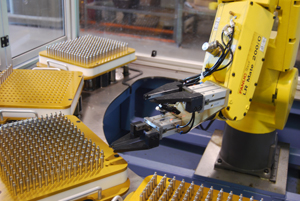 The robots work with a pallet system at the back of each machine, loading
stock and removing finished tools. Each pallet permits the ANCAs to operate
unattended overnight and through weekends.
The robots work with a pallet system at the back of each machine, loading
stock and removing finished tools. Each pallet permits the ANCAs to operate
unattended overnight and through weekends.
KEO Cutters found itself at a crossroads. The demands of the market meant
increasingly tighter tolerances and specifications for the toolmaker. To stay
competitive, the Warren, MI, company would have to put itself on the forefront
of innovation.
"We have a very strong brand name and we have been making excellent tools for
many years, but to compete successfully with new tool designs and larger
diameter tools, we knew we needed state-of-the-art capability," says Chuck
Curtiss, president of KEO Cutters. "We needed the capability to participate in a
range of spaces, including medical, aerospace, off-road, even jewelry making,
auto racing, Ivy League universities, automotive, and more."
KEO found that, like many users of machine tools, it had to expand its
capability in order to stay competitive against global players. With improved
capability comes an ability to increase throughput.
The company had been known for its center drills which are double-ended
tools, but in recent years has expanded its product range to include carbide end
mills, keyseat cutters, and dovetail milling cutters, countersinks and miniature
HSS steel end mills, and specials. Most of the production is high speed steel.
"We focus on the kinds of tools that most other tool makers
avoid, but which are very important to users," says Phil Samuels,
marketing vice president. "As a result, we have greater volume in
these tools than probably anyone else. That’s been the case from the
beginning in 1941."
Meeting the challenge
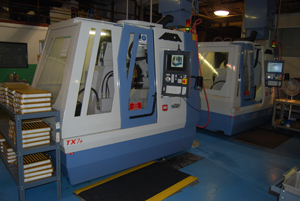 The lights-out capability was important for KEO, saving labor, improving the
consistency of production, and providing the capability to hold tolerances
on specials just as accurately as KEO does on standard tools.
The lights-out capability was important for KEO, saving labor, improving the
consistency of production, and providing the capability to hold tolerances
on specials just as accurately as KEO does on standard tools.
The investment KEO Cutters made in equipment has given the
toolmaker greater capacity and capability to meet the challenging
requirements of its most sophisticated customers.
To accomplish that goal, the company invested in three ANCA TX7+
production CNC tool and cutter grinding centers.
"The ANCAs allow us to produce tools we didn’t have the
capability to even consider prior to their installation about a year
ago," says KEO director of manufacturing Danny
Zuelch.
KEO ordered the advanced tool and cutter grinders with Fanuc
workpiece loading robots. The robots works with a pallet system at
the back of each machine, loading stock and removing finished tools.
Each pallet can hold up to 175 and 756 tools, depending on tool
diameter, which permits the ANCAs to operate unattended overnight
and through weekends.
Provided with a special wrist motion, the robots can flip tools
end for end so the machine can produce KEO’s double-ended tools
without missing a beat.
Lights-out capability
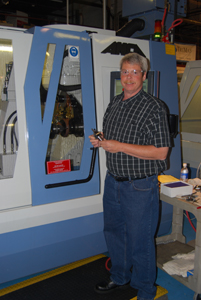 Danny Zuelch, KEO director of manufacturing, points out, “The ANCAs allow us
to produce tools we didn’t have the capability to even consider prior to
their installation about a year ago.â€
Danny Zuelch, KEO director of manufacturing, points out, “The ANCAs allow us
to produce tools we didn’t have the capability to even consider prior to
their installation about a year ago.â€
Since the ANCAs went to work, throughput has improved significantly.
For some tools, the turnaround from bar to shipping box has gone from 30
days to two days. Much of this has come as a result of the ANCA
capabilities, including the ability to changeover quickly and to handle
special customer requirements.
"The cycle time for some of our tools is not always shorter, but
our overall ability to deliver accurate tools quickly has improved a
great deal," says Zuelch. "The lights-out capability was huge for us
and saved a lot of labor, plus the consistency of production has
been improved — the first part is always the same as the last.
"And we have the capability to hold tolerances on specials just
as accurately as we do on our standard tools," he says. "At the end
of a day running specials, we can use the ANCA to run standard
products all night long. We just load the pallets, select a new
program, and hit ‘start’."
The ANCAs also are helping the toolmaker get better at what had
already been one of its specials: make any design or size of any
center drill, standard or special.
"Some center drills have angles, flats, and flutes all in a
specific relationship to each other," says Curtiss. "To try to make
a slightly different design in the conventional way would take a
great deal of time and be in queue with all our other work or we
would have to interrupt production to do the special. With the
ANCAs, we simply change angles, points, and specifications in the
program and have the tool done accurately tomorrow."
Since the ANCAs went to work, throughput has improved
significantly at KEO. For some tools, the turnaround from bar to
shipping box has gone from 30 days to two days.
This type of tool-making capability has allowed KEO to
successfully pursue more specialties.
"A lot of customers specify flute orientations, which means we
have to grind flats in relationship to the flutes within a couple of
degrees to the cutting edge," says Zuelch. "Previously, this would
be done with human intervention of the most skilled workers in the
plant. With the ANCAs we can do it faster and consistently first to
last. Lights out."
Streamlined process
The machining capability
of the powerful ANCAs also means that the company can streamline its tool
manufacturing process.
"With the ANCAs we also been able to eliminate a lot of milling
operations," says Zuelch. "Where tools used to be milled with a
milling cutter, we now can grind from a solid bar, which results in
a higher quality, more consistent surface finish.
"Standard drill making equipment has fixturing," continues
Zuelch. "And that takes some time to changeover, adjust, and tryout
to do another tool. On the ANCA, it takes me two seconds to tick in
the part program the angle I want to change, for example, and how,
and then I can drop the part complete. For that reason, we can have
a much faster turnaround with the ANCAs, rather than running a tool
through a series of operations through the plant. Workpiece handling
can add quite a bit of in-process time."
The design of the ANCA TX7+ allows for precision tool production.
The machines feature a 49hp, 10,000rpm spindle, an automatic wheel
changer, optional auto-loading system, and a 3000rpm headstock.
Built for rapid changeover
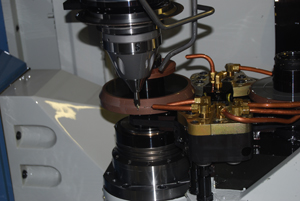 The design of the ANCA TX7+ is focused on precision tool production. The
machines feature a 49hp, 10,000rpm spindle, an automatic wheel changer,
optional auto-loading system, and a 3,000rpm headstock.
The design of the ANCA TX7+ is focused on precision tool production. The
machines feature a 49hp, 10,000rpm spindle, an automatic wheel changer,
optional auto-loading system, and a 3,000rpm headstock.
The TX7+ can be programmed to automatically perform a complete
changeover of wheel pack, coolant system, workholding collet, and pallet
in less than three minutes, allowing KEO to manage batch sizes and
handle specials seamlessly. Typical machines require 15 to 20 minutes,
to even several hours, for changeover to produce another type of tool.
For the TX7+, wheel packs and corresponding coolant manifolds are
prepared off-machine and quickly exchanged to grind a new tool.
The direct drive, high-speed (3000rpm compared to 200rpm
typically) work head (A-axis), allows the company to include
cylindrical grinding operations, preparing stock for its tool
grinding process, and to fully grind stepped or tapered blanks. OD
grinding for reamers and drills is also possible.
These capabilities mean tools can be produced complete in a single setup, and
this helps to minimize production time for many tools that may have required two
or more operations to complete.
The capability of the machines has actually allowed KEO to develop a system
for delivering tools quickly — called KEO KWIK.
In addition to speed of changeover, the CNC wheel changer allows the
manufacturer to utilize up to eight wheels in a single setup, accomplishing more
operations per setup and allowing complex and special tools to be dropped
complete. Mounted on a manifold, coolant piping changes with the wheel packs, so
that coolant flow is always tuned to the wheel in use for optimum coolant
application.
The TX7+ also includes in-process dressing which avoids some downtime and
helps assure optimum wheel condition, resulting in consistent grinding and tool
quality. Mounted to the back of the chuck on the high-speed work head, the
dresser roll is easily accessed or introduced to the wheels with minimal axis
strokes.
Now on the right side of the technological curve, KEO Cutters is well on its
way to meeting the demands of its customers for precision tools.
ANCA
What do you think?
Will the information in this article increase efficiency or
save time, money, or effort? Let us know by e-mail from our website at
www.ToolingandProduction.com or e-mail the editor at
dseeds@nelsonpub.com.