October 2008 Edition
productivity solutions
Making a better crusher
Software magic and new machines pulverize once costly method
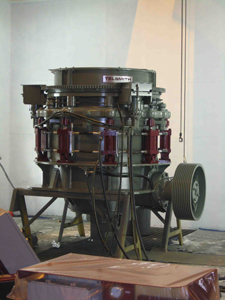 This completed Telsmith rock crusher has been painted in the paint booth.
Telsmith Inc., a manufacturer of rock-crushing
machinery in Mequon, WI, knows what happens when there’s an
unprecedented demand from mining companies responding to a dramatic
run-up in metals prices compounded by a weak U.S. dollar.
With its backlog at $44 million, the highest
level in decades, Telsmith has to do everything it can to meet
customer demand.
Telsmith productivity tools are Edgecam software,
two big CNC machine tools from MAG Industrial Automation Systems,
and high-grade carbide tooling from Kennametal Inc. A third machine
tool has been budgeted for late in 2008.
Responsibility rests with Dennis Van Asten,
manager of manufacturing engineering, two CNC programmers (Michael
Wier and David Worzalla), and the machining operators and
supervisors. Their efforts embrace faster setups as well as faster
machining.
The CAM programming is done with Edgecam from
Planit Solutions. Telsmith has relied on the program for over 10
years, and it is the one element of the productivity program that is
not new.
Telsmith’s mantra is "100 percent from the post,"
meaning that each program addresses everything for every job in the
postprocessor. In other words, part-program editing by overly
cautious machinists is a thing of the past. These "tweaks" can
greatly extend cycle times and deliveries, and it takes close
cooperation between Edgecam, Telsmith, and Giddings & Lewis.
Significant gains
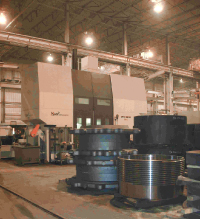 MAG Giddings & Lewis VTC 2500 vertical machining center with power-transmission parts are in the foreground. The machine cylinder with threads is for belt drives. Gray castings will have gear teeth cut into them.
Such cooperation led to sharp gains in
productivity in just a few weeks.
"New programming methods on the existing machines
have reduced most cycle times by 25 to 40 percent and in a few cases
by as much as 80 percent," Van Asten reports.
That alone has generated about $500,000 in
documented savings through speedier setups, he notes.
Van Asten, Worzalla, and Wier have been given the
go-ahead for long overdue changes in the way Telsmith makes parts.
That includes broad new initiatives in Six Sigma quality assurance
and the Toyota Production System.
Telsmith makes three types of rock crushers (jaw,
cone, and impact) in several sizes for mining, aggregates,
quarrying, road-building and related industries, plus screens and
feeders. Sales for 2007 were up sharply from 2006. Production
employment stayed the same. Employees work around the clock in three
eight-hour shifts plus a six-hour partial shift on Saturdays.
Telsmith makes all parts in-house except bevel gears and commodity
items such as bearings.
Parent company Astec Industries Inc.,
Chattanooga, TN, is the largest supplier of aggregate processing
equipment in North America, and Telsmith is the cornerstone of that
business.
The strategy
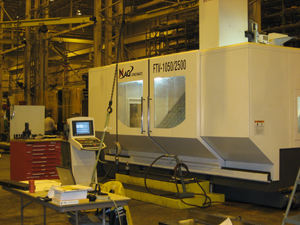 Telsmith’s new MAG Cincinnati also has a Sinumerik 840D.
Nearly all manufacturing-technology success
stories involve swapping out old vendors for new ones. This is not
the case at Telsmith. It has relied exclusively on Edgecam for 10
years and on G&L for 30.
The company also upgraded its design engineering.
It uses SolidWorks from Dassault Systèmes along with three licenses
of Edgecam Advanced Production (milling and turning) and three
modules of Solid Machinist for SolidWorks. Solid Machinist moves
SolidWorks part geometry into Edgecam, minimizing the chance a
programmer will miss an engineering change or small feature.
Warzalla notes that productivity gains were
achieved because Telsmith, Edgecam, and G&L all worked together
closely. Wier credits the successes with Edgecam, the G&L and
Cincinnati machine tools, and their Siemens CNC to the three most
important factors in a technology decision, "support, support, and
support."
The most dramatic results for Telsmith’s multimillion-dollar investments in machining, programming, and productivity have been reductions in cycle times on the old machine tools that generated $500,000 savings.
Until mid-2007, most machining was done on eight
1980s-vintage G&L HBMs and VTLs, prompting jokes that Telsmith was
"a G&L graveyard." The new G&L and the Cincinnati are the first new
machines in over 10 years, Van Asten says. The new machine tools:
- A four-axis Giddings & Lewis VTC 2500 — a
two-axis vertical turning center with a positioning table and a
right-angle head. For CNC, G&L recommended a Siemens AG
Sinumerik 840D.
- A three-axis Cincinnati vertical machining
center. This also has a Sinumerik 840D.
- A third new CNC, a large multi-axis machine
with integrated milling and turning was budgeted for mid-2008.
Making chips faster
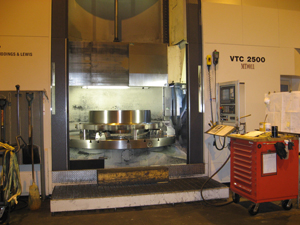 The workpiece in place can be seen through the open doors or the MAG Giddings & Lewis VTC 2500.
The most dramatic results for the company’s
multimillion-dollar investments in machining, programming, and
productivity have been reductions in cycle times on the old machine
tools that generated $500,000 savings, just in the first few months.
"Jobs that took a week before are now done in a
day and sometimes in four hours," says Van Asten. "The machine
operators compiled the numbers themselves and at first they didn’t
believe it."
Workpieces done on the new machine tools have
averaged 60 to 80 percent shorter cycle times. First, jobs no longer
sit idle with spindles turning the air during tweaks and edits. Also
gone are overly cautious feeds and speeds, a big factor in
Telsmith’s long machining cycles. With Edgecam programming and
upgraded cutting tools, feeds and speeds have increased tenfold.
"We have to make sure the program works and is
clearly understood no matter how fast it cuts," Wier says. "We are
using Edgecam to its fullest potential."
Two examples:
In-program probing macros— dozens of fully
automated probing cycles per part program. Done before almost every
tool change and new cut, these macros help eliminate the risk of a
tool crash.
Previously, each probe took five to 10 minutes.
Probing now takes 30 seconds so much more probing is done. Probe
data is automatically fed back to the postprocessor, eliminating one
more potential error risk and one more set of tweaks.
Threading macros— 42 pages of them and
variables for threading, in particular for buttress threads. With
their asymmetrical cross-section, buttress threads are best to
withstand the shock loads, vibration, and high stresses in rock
crushers.
Precise programming also means long hours in the
shop. Many of these hours are spent with the machinists.
"We want the machinists to give us feedback on
how the new programs run," Wier says. "We feel these extra efforts
will make a good machinist twice as good."
Return on investment
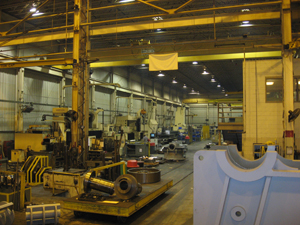 The vintage Giddings & Lewis VTLs can be seen along the far wall.
One of the most significant Telsmith
achievements has been financial — cutting the anticipated ROI on the
two new machine tools to about 18 months. The original projection
had been for up to six years.
Big customers were also impressed.
"We had representatives here from Caterpillar
when we ran off the G&L," Van Asten says. "They were amazed at what
we were able to do. Even the people from Kennametal were impressed,
and they were partnered with us all the way. This has been a huge
success for us and the word is getting out. Three of our sister (Astec)
plants have sent people here to see what we are doing.
"The Toyota Production System and Six Sigma are good and I would
not want to be without them. But to really advance, you have to
embrace machining technology wholeheartedly."
Van Asten and his team did something more than
just install new machinery, processes and methods at Telsmith. They
have installed, or perhaps better reinstalled, the ingenuity that
made American manufacturing a world leader in the first place.
Edgecam
MAG Industrial Automation Systems
Kennametal Inc.
Postprocessors are crucial
to CNC productivity levels
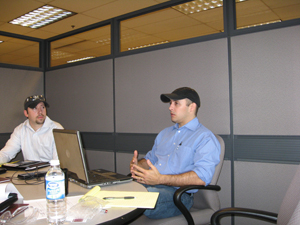 Programmers Dave Worzalla, left, and Mike Wier wrote the post for Telsmith’s second new machine tool, a large three-axis vertical machining center from MAG Cincinnati.
The challenge of writing postprocessors, or "posts," is the
technical complexity of the state-of-the-art machine tools. An integral part of
the CAM system, the post translates the programmed motion of the cutting tool
into G-code that machine tools "understand."
Postprocessors can be the Achilles heel of productivity of
new machine tools. If mishandled, they are the weakest link in the chain of
software and interfaces between design and manufacturing. Hundreds of individual
machine-tool functions must be addressed with each command routed through
thousands of electrical and electronic input/output (I/O) points that connect
the CNC to the machine tool’s servo drives.
Every machine tool action and every cycle sequence goes
through that I/O maze — spindles and cutters; all worktable and travel in the
machine’s drives; synchronizing those three/four axis with each other and with
the spindles and cutters; circular and linear interpolation, brakes, stops and
limit switches; and myriad other functions of tool changers, work holders,
dimensional offsets, sensors, instrumentation, coolant on-off, safety
interlocks, CAM program download, and so forth.
"Postprocessing is a big thing for us," says Michael Wier,
CNC programmer at Telsmith Inc. "The Edgecam postprocessor module, Code Wizard,
lets us change the posts and work with them effectively. That makes it easy to
adapt existing programs to small engineering changes."
Wier and fellow programmer David Worzalla wrote the post for
Telsmith’s second new machine tool, a large three-axis vertical
machining center from MAG Cincinnati.
What do you think?
Will the information in this article increase efficiency or
save time, money, or effort? Let us know by e-mail from our website at
www.ToolingandProduction.com or e-mail the editor at
dseeds@nelsonpub.com.