May 2008 Edition
plant strategies
Slashing energy costs
Strategies from CNC Software, GE Fanuc, TRW, 3M, and DuPont
demonstrate how efficiency, alternative sources can add to bottom line
By Peter B. Alpern, Associate Editor
Riverdale Mills cultivated a name in innovation by
building a better lobster trap. For centuries, lobster traps had
been made of wood, which rots quickly in the salt water off New
England. Jim Knott took a different approach by devising more
durable traps from metal wire dipped in plastic.
His vision, first born more than 40 years ago,
has grown into a 90-percent stronghold on the industry and grosses
just under $20 million a year. But Knott’s greatest innovation —
perhaps even more intriguing — lies far beyond seafood or wiring.
Riverdale Mills generates its own electricity —
an invaluable advantage for a company with only 100 employees. A
combination of natural gas-fired generators and a hydropower turbine
allows Riverdale Mills to run its machinery for a fraction of what
it would cost for power from utility companies.
As the price for energy inches skyward,
commercial and industrial sectors are being forced to find
innovative methods to save on costs. Some manufacturers, such as
Riverdale Mills, are investing heavily to create self-sufficiency.
Other companies have found simply tweaking their production
processes can result in significant savings.
One way or another, a new era seems to be bearing
down on the industrial sector and companies are having to change.
"You’d better bite the bullet while you can or
you’ll get eaten alive," says Knott.
The growing threat
It wasn’t so long ago that the price of energy
mirrored that of another vital resource: steel. For over 20 years,
manufacturers indulged in a plentiful market in which steel hovered
between 15 to 17 cents per pound.
Those days are over. Today, steel costs closer to
44 cents a pound. Zinc, another valuable metal, has quadrupled in
price.
Expensive oil and metal — coupled with the
subprime mortgage crash, shaky credit markets, Wall Street
turbulence, tensions with Iran and a feeble dollar — have many
fearing inflation and the threat of an extended recession in the
United States.
"It puts us in a position in having to make some
uncomfortable choices," says Gary Novak, health, safety and
environmental manager at TRW Automotive. "But it’s a reality and
everybody’s got to deal with it."
According to Steve Schultz, corporate energy
manager at 3M, the cost of energy to run its facilities rose between
70 to 80 percent over the last five years. In the past 14 months
alone, the price for crude oil skyrocketed from $60 per barrel to
over $100.
Companies are now accepting the current and
long-term trend for oil, natural gas and coal prices and taking
measures to invest in energy efficiency to help fight rising costs
and optimize power.
"The energy used by the American industrial
sector surpasses the energy consumed by the entire Japanese
economy," says Department of Energy Secretary Samuel Bodman,
"meaning, the potential for energy savings in this sector alone is
tremendous."
Educating and organizing
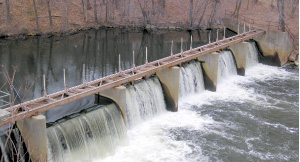 Jim Knott restored this 1901 hydropower turbine on the Blackstone River and its civil works at a cost of $130,000, saving an average of $100,000 a year. He has also built an exhaust system onto his diesel-powered generators, transforming the heat given off from the engines into more energy, using cogeneration.
Industry uses more than one-third of the energy
consumed in the United States — a staggering total made all the more
powerful by estimates from the U.S. Department of Energy that
manufacturers are capable of saving between 20 to 30 percent of
energy consumed by making simple procedural adjustments.
Half the challenge of being able to cut energy
costs lies in identifying the problem, says 3M’s Schultz, citing
organization as the single greatest energy-saving tool.
"If a company’s going to determine if they are
making improvements or not, it might be a good idea to start by
establishing metrics within the manufacturing plant of how much
energy was used and how much product was shipped out on a particular
month or year," he says. "The emphasis really doesn’t have to be on
hardware — it should be on people. We recommend activities to make
people aware of the opportunities to use less energy."
Auditing oneself often reveals a number of low-
or no-cost adjustments that pay dividends immediately. A good
example, says Schultz, is shutting off steam mains that serve
abandoned process lines.
Brian Weber, Lean promotions officer at TRW’s
Fenton and Fowlerville facilities in Michigan, estimates that each
facility consumes roughly $1.5 million a year in electricity.
"One of the easiest things we considered was
which of our equipment are we running that we don’t have to," says
Weber. "Some of our assembly lines have 30 or 40 [machines] going at
once and we start shutting some of those down if we don’t need them.
You’re just trying to be practical and cost-efficient."
Taking bold steps
Whether the motivation is for positive publicity
or the incentive of saving millions of dollars, some of the largest,
most powerful corporations in the world are discovering that
becoming greener benefits the bottom line.
ExxonMobil pumped in over $1 billion in
cogeneration projects between 2004-05, drawing off the simultaneous
production of electricity and steam using natural gas. According to
several studies, cogenerated power is nearly twice as efficient as
traditional methods of producing steam and power separately.
ExxonMobil has 98 such facilities around the
world and has reported reducing its global CO2 emissions
by more than 10.5 million metric tons annually — the equivalent of
taking 2 million cars off the road in the United States.
DuPont Titanium Technologies, one of the world’s
largest manufacturers of titanium dioxide, cut its energy
consumption per pound of product by nearly 30 percent — saving an
estimated $100 million since 2001.
DuPont invested aggressively in replacing aging
electric motors with new, more efficient models, while upgrading
plant rooms with new hardware and software. Many of DuPont’s plants
implement technology for energy recovery and reuse, such as
salvaging heat energy from steam.
"It all adds up, one motor and one valve at a
time, day after day," says DuPont’s Vice President and General
Manger Rick Olson.
That DuPont targeted electric motors directly is
significant. According to General Electric Fanuc Automation,
electric motor equipment accounts for 64 percent of the electricity
consumed in the United States industrial sector. All told, those
systems consume 290 billion kWh per year — nearly 21 percent of
annual machinery operating costs.
One of the more recent advances companies have
tried to make is installing adjustable speed drives for motors with
a variable load. In years past, air handling and pumping systems
were designed with motors that ran at constant speeds and were
controlled with a differential pressure bypass valve. Beyond the
cost of energy, the system was largely inefficient, says 3M’s
Schultz. With adjustable speed drives, the user controls the speed
of the motor and therefore the volume of material pumped in,
providing significant energy savings.
"If you can reduce the speed of a motor by 50
percent, it’ll use only 1/8 of the energy that it was using at full
speed," Schultz says.
Tapping new sources
When CNC Software released Mastercam 24 years
ago, it became one of the most widely-used CAM program suites on the
market. But CNC’s margin for profit has increased recently as a
result of unconventional thinking and bold investments.
When CNC moved into its headquarters to Tolland,
CT, in 1989, company President Mark Summers requested geothermal
heat pump systems be installed. Instead of using a conventional
boiler and air conditioner to heat or cool CNC’s offices, a
geothermal system transfers the more moderate temperatures stored
beneath the Earth’s outer crust and blows it through the office
vents.
The system saved CNC approximately 33 percent on
costs than standard cooling methods as recently as five years ago.
But with the continued spike in energy prices, Summers estimates his
savings will only continue to soar into the future. He has recently
installed a large-scale commercial solar panel that will further
diminish CNC’s reliance on purchasing electricity.
The problem companies face, says Summers, is
coming to terms with the upfront cost — knowing savings might not be
felt for years down the road.
"It’s a staggering upfront investment, but
there’s a much bigger picture than getting the return," he says.
"The humanitarian side should be what’s driving this thing.
Unfortunately, what drives business is money. Everybody is talking
about the cost of gas like it’s a bad thing. But what it’s going to
do is get us thinking and acting quicker because it’s hurting us in
the pocket book. It makes you think creatively."
Which is one of the principal reasons why
Riverdale Mills has been so successful in its wire-mesh industry.
Back in 1979, the company’s founder and
president, Knott, found himself in a legal dispute with a local
electric company over who should cover the costs associated with
channeling power to his Northbridge mill building. Exasperated by
the process, Knott resolved to make his company self-reliant. Knott
restored a 1901 hydropower turbine and its civil works at a cost of
$130,000, saving him an average of $100,000 a year. He has since
built an exhaust system onto his diesel-powered generators,
transforming the heat given off from the engines into more energy,
using cogeneration.
"If you keep your costs down, you can offer lower
prices," says Knott.
Looking toward the horizon
DuPont’s sustainability manager, Eddie Johnson,
has a favorite anecdote: for years, DuPont has offered customers
free energy surveys of their facilities to identify opportunities to
reduce energy consumption.
Until recently, the program had only received
tepid interest.
"But suddenly with oil at $110 a barrel and gas
at more than $10 a cubic foot, there’s interest — even if only to
reduce the electrical bill for lighting," says Johnson. "Before, the
perception was that the savings were trivial. People are suddenly
interested because it’s real money now."
Predictions vary as to how much of energy
expended today can truly be saved. Pedro Haas, an energy expert at
McKinsey & Co., suggests that the growth rate of worldwide energy
consumption could be cut by more than a half over the next 15 years
simply through more aggressive energy efficiency efforts.
The federal government has also taken some steps
to promote energy efficiency and conservation. The likelihood of a
federal tax on carbon emissions is rising, and some in Congress have
called for higher taxes on oil and gas companies to fund investments
in cleaner, more renewable energies.
In 2007, Congress voted to increase Corporate
Average Fuel Economy Standards to 35 mpg average fuel efficiency for
fleets of passenger cars and light trucks. The increase was the
first change since a 1975 law mandated 27.5 mpg. The Environmental
Protection Agency’s Energy Star program, which promotes
energy-efficient products such as refrigerators and residential
heating systems, has expanded significantly since it was initiated
in 1992.
Ultimately, how companies adjust to these rising
costs and shorter supplies — and how deftly they handle the
malestrom of a changing landscape — will determine their viability.
"For the last 100 years, we’ve been spoiled by
how cheap energy was," says CNC Software’s Summers. "But now I think
we’re just beginning to see what we, as an industry, are going to
have to do to function. We’re running out of cheap energy and we
have to get a lot more creative and efficient with how we use it."
3M
CNC Software
DuPont Titanium Technologies
Exxon Mobil
GE Fanuc Automation
McKinsey & Company
Riverdale Mills
TRW Automotive
What do you think?
Will the information in this article increase efficiency or
save time, money, or effort? Let us know by e-mail from our
website at
www.ToolingandProduction.com or e-mail the editor at
dseeds@nelsonpub.com.