May 2008 Edition
larger margin
 Dennis G. Seeds
Editor-in-Chief
Plug the brain drain
Companies’ new offense fights decline in skilled worker levels
The headline said, "Skilled Worker Shortage Dims Growth
Picture." It wasn’t from a current newspaper. It was from The Los Angeles
Times, and it was dated March 19, 1978. It was about a supplier planning to
move out of state because he couldn’t find skilled workers.
A headline like that easily could have been written in any
publication today. The skilled worker employment situation hasn’t changed much
over three decades; the headlines are still reporting a shortage of skilled
workers — machinists, oil workers, defense workers, welders, plant electricians,
skilled draftsmen, and others.
Ever since the industrial revolution started, there have been
shortages of skilled workers at one time or another. When a new manufacturing
process was invented, it likewise created a demand for skilled workers. In the
example above, the computer field needed workers.
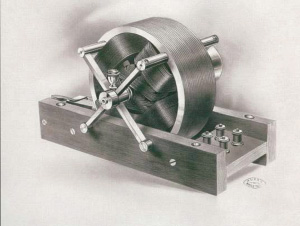 One of Tesla’s original 1888 electric motors.
In the 1860s, the Civil War created a demand for arms, which
in turn produced the idea of mass production by new machinery. Along with mass
production came the idea of interchangeable parts, and a new realization — that
machines were capable of amazing accomplishments.
Steam engines had been introduced into factories and filled
the need adequately for power. However, they posed their own problems. They were
less than 20 percent efficient.
Manufacturers soon found out that this scenario needed
simplification. While the direct current motor had been invented earlier, the
alternating current motor (invented by Nikola Tesla in 1888) displaced the DC
motor. The AC electric motor had a rotating magnetic field that made electric
drives for machines feasible and made power transmission necessary. The AC motor
became king of the hill. Companies such as Cincinnati and Browne and Sharpe
designed and manufactured quality, specialized machinery: the turret lathe, the
automatic screw machine, mills and grinders, and sheet metal punches. Nearly all
modern machines can trace their roots to these machines of the early 1900s.
Along came the first "engineers" with college degrees. These
were theorists, fortified with mathematics knowledge, but who had little
practical experience. Thus was born a situation that still exists — the conflict
between the college-educated engineer and the machine-savvy shop foreman.
The Associated Press recently reported that Northrop Grumman
Corp. would have about half of its 122,000 workers eligible to retire in the
next five to 10 years. Likewise, at Lockheed Martin Corp., half of its 140,000
workers could retire in the next decade. Boeing has 15 percent of its engineers
55 or older eligible to retire now.
Those numbers might not be so worrisome if there were
qualified young workers to take their place. The Higher Education Research
Institute at UCLA last year conducted a survey of more than 270,000 college
first-year students and found that only 7.5 percent intended to major in
engineering. This represents the lowest level since the 1970s.
The well-established automotive, oil, and
aerospace industries may seem boring to college students lured by
the splash of Internet search engine Google or a biotechnology
leader such as Genetech.
Lockheed Martin Corp. is partnering with Project
Lead the Way to help cultivate in grades K-12 the next generation of
engineers. Rolls-Royce PLC helps fund British high school courses
such as engine propulsion.
Lockheed Martin’s efforts in particular have received broad
exposure in the press. The program offers eight full-year high school
engineering courses and five middle school modules, all of which employ rigorous
problem-based learning experience and integrate mathematics and science.
Engineers go into classrooms as guest lecturers and coaches.
They develop a relationship with the students, becoming their role models and
mentors. Students who have completed the program are five times more likely to
major in engineering than the national average.
The solution of the future engineering and technical workforce shortage lies
in a system-wide approach through a vibrant partnership with corporations. The
solution may also be in companies that provide flexible schedules, tuition
reimbursement programs, and chances for advancement. It will take education and
support, and we can do it. We owe it to ourselves and our children.

What do you think?
Will the information in this article increase efficiency or
save time, money, or effort? Let us know by e-mail from our
website at
www.ToolingandProduction.com or e-mail the editor at
dseeds@nelsonpub.com.