March 2008 Edition
machining strategies
Southern strategy: Cut inventory while shortening those lead times
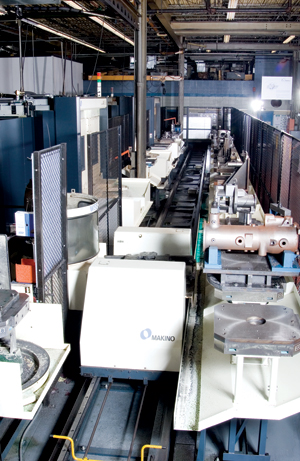 Most recently, Quincy installed a Makino Machining Complex, consisting of two Makino A88 four-axis horizontal machining centers (18,000rpm spindle speed), and then shortly after upgraded its cell to include an A88E high-speed horizontal machining center (12,000rpm spindle speed).
As a manufacturer, Quincy Compressor Inc. of Bay Minette, AL,
has come a long way from its days assisting dairy farmers.
The origins of Quincy Compressor go back to 1920. George
Gille, John Kathe, and George Wall started the Wall Pump and Compressor Co. in
Quincy, IL. The company's flagship product line was a series of vacuum pumps
designed for milking cows. By 1924 the company changed its name to the Quincy
Compressor Co. and expanded its products to meet the growing demand for
industrial air compressors. In 1937, the company introduced the Quincy QR-25, a
reciprocating air compressor that quickly became an industry standard.
While Quincy Compressor sells a variety of products for the
creation and treatment of compressed air, its specialty is manufacturing custom
rotary screw and reciprocating air compressors with the industry's most reliable
air end. The company manufactures a variety of rotary compressors, ranging from
5 to 500hp. The quiet and reliable compressors are built for 24-hour operation.
Quincy manufactures 3- to 30-hp gas or electric reciprocating compressors.
Quincy serves an array of markets with compressed air
systems. Reciprocating products are used in general industrial, energy
exploration, medical applications and natural gas extraction/transmission and
climate control. Rotary screw compressors are used in energy/petroleum,
concrete/construction, printing, textiles and agriculture.
As a business operation, Quincy Compressor plays a Southern
strategy today. It is headquartered at the company's rotary screw compressor
manufacturing, testing, and assembly plant in Bay Minette. Some components are
manufactured in the United States and sent to China for assembly and sale in
Asia, but all North American sales are manufactured and assembled in the United
States.
Seeking flexibility
Quincy experienced substantial growth in the industrial air
compressor market over the past several years. Even so, the company knew it had
to increase its market share to guarantee future growth. As a result, the
company concentrated on increasing its manufacturing efficiency and flexibility
to meet the demands of today and tomorrow.
"While contract manufacturing would have eased our capacity
constraints, the high costs and risks of having large queues of high-precision
components encouraged us to look elsewhere," says David Peed, manufacturing
engineer and machining team leader at Quincy. "A more favorable option was to
purchase new, more efficient equipment."
The sale volumes of rotary screw compressors were creating
capacity constraints in Quincy's precision stator machining area despite efforts
to balance machine loads to exploit capacity. The planned introduction of new
air ends further complicated machine loading and required increased flexibility
to accommodate new models. This capacity constraint was compromising the
company's ability to respond to increased business opportunities for service air
ends, short lead-time orders, and new product introductions.
In 1995, Quincy installed a two-machine Makino MC98 cell with
16 pallets. That cell is still running static parts, inlet valves, discharge
ends, and end caps. Since this wasn't Quincy's first experience with Makino, it
again turned to Makino for precision and reliability.
Precision was a serious concern for Quincy. The machining
process of the air compressor housing requires four parallel bores to be
machined, two from each side of the cast housing, two of which are approximately
10" in diameter and 17" deep.
"We've found that running deep, wide bores, while keeping the
tolerances down to 0.001" true position in many cases, beats up machine tools
pretty fast," says Peed. "The cutting forces, along with the large amounts of
material removed, can wreak havoc on tooling, the spindle itself, the chip
conveyors, and countless other features of the machine."
Because Quincy manufactures a complete product totally
in-house, the company is its own machining customer. When machines go down or
deadlines are not met, it directly impacts on-time delivery and on-budget
performance. This significantly affects the bottom line and could ultimately
tarnish Quincy's image.
"We're a very efficient company," adds Peed.
Complex solution
Most recently, Quincy installed a Makino Machining Complex,
consisting of two Makino A88 four-axis horizontal machining centers (18,000rpm
spindle speed), and then shortly after upgraded its cell to include an A88E
high-speed horizontal machining center (12,000rpm spindle speed). The complete
cell utilizes a 30-pallet flexible manufacturing system to improve the machining
of air compressor housings and air inlet castings. An automatic 244-tool changer
on each machine accommodates all the necessary tools for common jobs.
The manufacturing processes on the Makino MMC produce stator
components from raw castings to finished machined components in one process.
Quincy is using two of the A88s to run inlet castings, while the third is used
for small rotary housings and overflow work.
Whereas the typical machine in Quincy's operations requires
one operator to run two machines, one operator can run three machines in the
Makino cell. Using the new Makino cell, Quincy has reduced cycle times and
increased spindle utilization, capacity, and flexibility with the ultimate goal
of lowering inventory levels of finished products and decreasing lead-times to
internal and external customers.
"I'd say we reached those goals," continues Peed. "We reduced
cycle times by 25 to 30 percent. We are maintaining process capabilities of
1.33cp to as high as 1.92cp on the Makinos. We're also impressed with the
dynamic accuracies and thermal stability of the machines, as well as the
rigidity of them under heavy loads."
Flexibility is key
In addition to cycle time or other measurable metrics, Quincy
was also impressed with the flexibility that the Makino cell offered.
"Flexibility is the key," says Peed. "We can quickly change
priority of one part and start another part on the machine without interrupting
production.
Designed to improve manufacturing efficiency, the MMC2 is an
enhanced pallet management system created to meet the increasing and changing
demands of customers. The system assigns work and initiates operations
automatically based on machine and material availability, utilizing maximum
spindle capabilities and monitoring all automated procedures.
The MMC's cell controller can handle an unlimited number of
parts, and can process an unlimited number of steps per part. In addition, it
can handle unlimited different parts per pallet and utilizes production order
management software that tracks order numbers, part numbers, quantities, dates
required and priorities.
This flexibility allows Quincy to produce parts in a
just-in-time manner for each order as it moves through production. To ensure
automated production, Quincy also needed a local partner.
Single source technologies
Single Source Technologies partnered with Makino to help
deliver the automated system for Quincy. SST served as a local resource
providing engineering services, supplies, application support and customer
service. SST ensured Quincy's Makino cell would be up and running smoothly
without any delays in its production operation.
Installation took place in two phases to minimize
interruptions to Quincy's manufacturing operation. Sales volumes were at a
record high, and production levels were requiring 24/7 operation. The company
had the first two machines and 16 pallets installed and started into production.
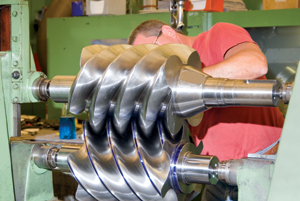 While Quincy Compressor sells a variety of products for the creation and treatment of compressed air, its specialty is manufacturing custom rotary screw and reciprocating air compressors with the industry's most reliable air end.
Makino then set the third machine, laid new rails, moved the
load/unload station as well as the cell controller with minimal interruptions to
production. Makino worked with the operators to time down periods of the cell
vehicle with long run jobs inside the machines. By doing this, Quincy met all of
its production demands and on-time deliveries.
In addition to reducing cycle times, the Makino cell has
helped Quincy evolve its Continuous Flow Manufacturing capabilities. Since the
early 1980s, Quincy has focused on CFM, a manufacturing strategy that produces a
part via a just-in-time production approach, at its Bay Minette plant.
Since then, Quincy has been improving its build-to-order
environment, balancing its production lines to reduce waste and cost while
delivering on-time and defect-free parts. The Makino cell allows for continuous
production and quick turnaround, allowing parts to pass onto assembly in the
same building. The Makinos also allow for repeatable and predictable part
manufacturing as orders arrive.
"The Makino cell is one of the major advancements in the
machining area," explains Peed. "It has provided us with the ability to increase
flexibility and throughput while reducing inventories of both raw and finished
goods."
The company plans to expand its business into China, India,
Southeast Asia, Latin America and the Middle East, manufacturing the compressors
in the United States.
"We need to make sure all of our systems will provide the
most efficient means of manufacturing our compressors, from start to finish, and
allow us to ship the finished, customized product in the time our customers'
demand," says Peed. "With our Makino cell, we're able to accomplish that goal
and expand our business."
Makino
What do you think?
Will the information in this article increase efficiency or
save time, money, or effort? Let us know by e-mail from our
website at
www.ToolingandProduction.com or e-mail the editor at
dseeds@nelsonpub.com.