June 2008 Edition
managing for tomorrow
Casting call
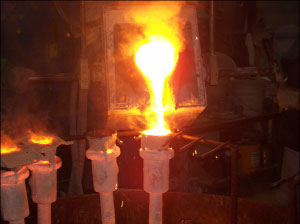 Wax is removed from the pattern material by heating the ceramic mold in a
high-heat furnace. The material is lost, and molten metal is poured into the
ceramic mold.
Wax is removed from the pattern material by heating the ceramic mold in a
high-heat furnace. The material is lost, and molten metal is poured into the
ceramic mold.
Forming metal parts in disposable molds can save time, material
Used to form precise and intricate metal shapes, investment
casting can offer tool and die makers, machine operations, and their
customers considerable finishing plus savings of time, material and
labor. The process — forming metal parts in disposable molds —
offers opportunities to create "near net shape" parts of virtually
any metal.
If an operation is fabricating parts out of bar metal, chances
are it’s costing extra time and money. If those parts require
machining, there could be a loss of significant money in scrap,
especially if expensive metals or alloys are used.
Investment casting offers flexibility of alloys while saving
finishing time and material waste. The range of metals and alloys
that can be investment-cast is wide: aluminum, stainless steel,
cobalt, and Inconel.
The process can also combine two or more parts into a single
piece, saving on fabrication, welding or assembly, and machining
time.
Parts between 1 ounce and 30 pounds in weight can be
investment-cast in close tolerances with surfaces that require
little finishing.
A growing number of operations that make intricate metal parts,
or parts requiring repetitive, extensive machining, are finding that
investment casting is a solution.
Savings in the long run
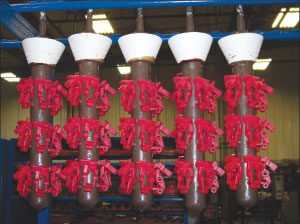 After the metal parts cool and solidify, they are removed for the investment
material and are inspected for quality.
After the metal parts cool and solidify, they are removed for the investment
material and are inspected for quality.
"I suppose that some fabricators look at the somewhat higher
initial cost and don’t realize all the savings of investment casting
in time and materials, saving money in the long run" says Carl
Johnson Jr., vice president of Staten Island Machine Shop Inc. of
Staten Island, NY. "Plus they can produce a better part."
Johnson, who produces metal shafts as well as plate and sheet
metal, explains that the stainless shafts he fabricates are
investment-cast rather than cut from bar stock or formed by sand
casting and then finished.
"For one thing, in this part of the country, it is becoming
difficult to find qualified machinists," he says. "There are few
machinists or CNC operators coming out of the schools today, and
that — as well as the cost of equipment and labor — has become a
problem for many machine operations.
"To an extent, investment casting alleviates this problem,
because it eliminates some of the burden of machining."
Several years ago, Staten Island Machine Shop began having some
of the parts it previously had sand-cast instead supplied by Rimer
Enterprises of Waterville, OH, a state-of-the-art investment-casting
specialist that serves industries ranging from railroad to food
processing.
Investment casting offers flexibility of alloys while
saving finishing time and material waste. The range of metals
and alloys that can be investment-cast is wide: aluminum,
stainless steel, cobalt, and Inconel.
Johnson adds that the stainless steel gears his operation now
gets from Rimer, typically for marine applications, are
high-precision parts that slide over or under other components. In
the past, when the gears were made from sand castings, there could
be significant shifting or other movement.
"This problem is far less likely to happen with investment-cast
gears because the rotations are right on, the holes are exactly
where they should be, and all critical dimensions and tolerances are
very close, which also minimizes the need for machining," he says.
Savings in metal
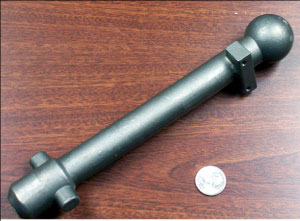 After the metal parts cool and solidify, they are removed for the investment
material and are inspected for quality.
After the metal parts cool and solidify, they are removed for the investment
material and are inspected for quality.
While reducing the demand on machine time is a savings, there is
also added savings in costly metals used to fabricate many parts.
Chuck Myers, president of Rimer Enterprises, says that depending on
the metals and alloys used to make the castings, the differences in
material costs could be stunning.
"For example, if you are machining a piece of stainless steel
that costs $5 per pound, you might be machining 80 percent of the
steel out for your finished product," Myers explains.
"By the time the part is finished, you’ve got four pounds of
stainless steel chips that you end up selling to a scrap dealer for
$2 per pound. If the same part is investment-cast, the near-net
shape virtually eliminates the scrap, which could represent many
dollars in savings per part in alloy cost as well as labor."
The general manager of another Ohio-based machine operation says
that one of the main reasons he buys investment castings is that he
can’t get the needed material in bar stock and prefers not to use
sand castings. However, the savings on materials are also
significant.
"The advantage of getting a near-net shape means less machining
and also material savings," he explains. "So, when you make parts
with alloys, such as the nickel-based alloys that we use, there is a
pretty significant cost savings because you don’t have to throw half
of the metal away in chips. And of course, the machine time is less
when you have parts that are cast pretty close to size."
This operation, which also has its investment castings made by
Rimer, recognizes that the consistency of investment-cast products
is a noteworthy benefit. While investment casting may provide
quantum savings in terms of time, material and labor, some have
concerns about turn-around time.
"When we need castings, it is usually because a customer is
running the same part except that the dimension may change," the
general manager says. "We try to stay ahead of the game but we can’t
anticipate how long their production runs are going to be. So, if we
get caught short, any delay in turnaround time can really hurt."
In anticipation of such problems, Rimer made substantial new
investments in its in-house capabilities when it took over ownership
of the business several years ago. For example, the company
installed a robot-dipping system to reduce lead-time and improve the
consistency of products. The newly expanded facilities also include
a modern CNC tooling shop and a CNC machine shop for machining
castings.
"Turnaround time in our industry is often 10-12 weeks," Myers
says. "We have been able to cut that time more than 60 percent. In
emergency situations, we will do everything we can to turn around
the needed castings as quickly as possible."
Rimer Enterprises
What do you think?
Will the information in this article increase efficiency or
save time, money, or effort? Let us know by e-mail from our website at
www.ToolingandProduction.com or e-mail the editor at
dseeds@nelsonpub.com.