June 2008 Edition
workholding
Making order out of ‘chaos’
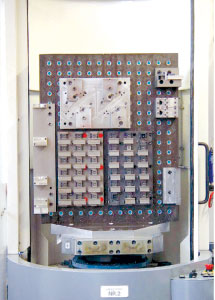 In the “chaotic†clamping system, complete subassemblies are partially removed, ready for final assembly.
Modular principle, multi-part clamping key to reducing operating costs
Through the use of flexible, multi-part clamping
for complex parts, an Illinois operation has successfully produced a
21-hour machining cycle using only one manned shift. Also, the
company priced out the manufacture of typical parts to China being
machined in this new way and only the three-part order could be
produced at a lower cost, without the shipping cost and time
considered.
Solving complex part manufacturing requires three
key elements, according to the workholding fixture manufacturer in
this case, Triag. Advanced Machine & Engineering of Rockford, IL,
builds the Triag brand of workholding devices in the United States.
Fixtures need to be flexible, modular and
variable. To be flexible, the fixture must be suitable for various
cutting conditions. It must also be adaptable to a wide assortment
of materials, weights, sizes and configurations, whether used on a
three-, four- or five-axis machining center.
Modular means the design principle of the fixture
must be such that it allows the clamping devices to move and be
repositioned on the fixture faces in different setups, often within
the same job run.
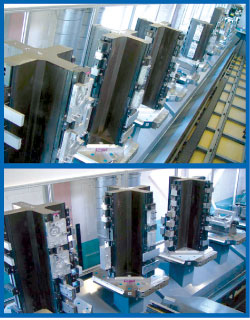 At Profiform, these tombstones with various loads are inside the flexible manufacturing system.
Variable means the fixture must adapt to the
particular machining center characteristics of mounting, access to
the cutting theater and shuttling, with little or no modification.
The company, Profiform AG, is located in the town
of Adligenswil, near Lucerne in Switzerland. Opened in 1987, the
company began with vertical machining centers and simple clamping
vises. In 2002, the first flexible manufacturing system was
installed, allowing the first unmanned production to be
accomplished. This resulted in immediate improvement in the overall
productivity, as well as cost containment for the owners.
Currently, the heart of the operation’s FMS is a
Mazak PFH 5800 four-axis HMC, with XYZ movement of 730mm x 730mm x
740mm. A 16-pallet rack, equipped with Tripoxy tombstones up to
960mm high, and 378-position toolchanger are onboard this formidable
workhorse.
In the "chaotic" clamp setup, complete
subassemblies are partially removed, ready for final assembly.
Single large-part fixturing and/or the clamping of several small
parts simultaneously are done. This chaotic clamping setup means
constant change to the clamping location, which is performed by the
Triag Powerclamp system. On more "organized" setup, the same part is
clamped in all stations on the tombstone.
Typically, Profiform machines forged and cast
parts, structurals, saw cuts, profiles and parts up to 400mm x 400mm
x 50mm (15.75" x 15.75" x 1.97") in materials ranging from aluminum,
stainless and tool steels to various plastics and composites.
 For its clamping system, Profiform required
process safety through rough milling, as well as the clamping of
pressure-sensitive parts; maximum flexibility in terms of the
clamping techniques employed; maximum clamp density for optimum
space utilization; short setup times and ease of use. Triag
responded with the modular Powerclamp design, consisting of a base
rail, used as a support unit for the clamping modules, and the
Microclamp fixture system for smaller parts, which runs on the same
base rail design.
For its clamping system, Profiform required
process safety through rough milling, as well as the clamping of
pressure-sensitive parts; maximum flexibility in terms of the
clamping techniques employed; maximum clamp density for optimum
space utilization; short setup times and ease of use. Triag
responded with the modular Powerclamp design, consisting of a base
rail, used as a support unit for the clamping modules, and the
Microclamp fixture system for smaller parts, which runs on the same
base rail design.
In a typical 21-hour running production day, only
one shift of operators is required, during which all the worker
know-how is brought to the task of efficiently scheduling and fixing
the workpieces into place on the various stations, then programming
the FMS to execute the runs. As a result of this system, 13-14 hours
of unattended running time are translating into a decided
competitive advantage for Profiform.
The company has priced out the production of various finished
products, in small, medium and large batch runs, to China and found
only the small quantity was made at a lower cost, with no shipping
cost or time factored. This scenario boosted the confidence of both
the company and its customers in the value of this workholding
system.
Triag USA
What do you think?
Will the information in this article increase efficiency or
save time, money, or effort? Let us know by e-mail from our
website at
www.ToolingandProduction.com or e-mail the editor at
dseeds@nelsonpub.com.