June 2008 Edition
honing/finishing
Double-digit Cpk levels
CNC-controlled honing technology is first-place winner for gear company
By Rich Moellenberg
 A large-bore gear is about to be honed with a Sunnen CGT Krossgrinding tool. The tool allows control of bore size to 0.00005".
Offering the capability to size and finish bores
precisely at high Cpk levels, a new generation of CNC-controlled
honing technology is changing the image of a messy, manual secondary
process and taking on a primary role for makers of small engines
(<50hp), gears, and fluid power components.
Working at process capability levels of 1.67 and
above in an automated environment, honing can control hole size with
quarter-micron accuracy, correct geometric errors in the bore, and
produce a specific surface finish with lubrication and seal
enhancing properties.
Makers of outdoor power equipment, motorcycles,
ATVs, hydraulics, pneumatics, gears, and valves, to name just a few,
are discovering automated honing in their search for ways to make
parts with tolerances as tight as ±0.0002" (±5 µm) at high Cpk
levels.
Wherever a part rotates on a shaft or a piston
slides inside a bore, manufacturers are adopting honing to improve
performance. The goals:
- Gearboxes and transmissions that run quieter,
smoother and longer.
- Hydraulic systems that are more precise,
responsive, efficient, and leak-resistant.
- Small engines that deliver higher power
densities and produce less pollution.
Why honing?
The force driving the resurgence for honing is
twofold:
1. Primary metalworking processes, such as boring
and reaming, have difficulty hitting ultra-precise geometric,
dimensional, and surface specs with Six Sigma and higher process
capability.
2. Manufacturers are tightening part specs to
achieve greater efficiency, tighter sealing, lower exhaust
emissions, quieter operation, and longer life.
Various holemaking processes, such as boring,
drilling, and reaming are
capable of producing excellent tolerances, but when a high Cpk
requirement is imposed, it changes the picture entirely.
For rule-of-thumb purposes, when the target is
1.33 Cpk, manufacturers find they have to hold about 60 percent of
the print tolerance; at 1.67 Cpk, it drops to about 40 percent of
tolerance. Holes produced satisfactorily on a lathe for years that
suddenly have to meet process capability of 1.33 or 1.67 Cpk may
require a much narrower bell curve of distribution. "Flyers" at the
fringes of the curve become unacceptable.
Why does a high Cpk constrict the tolerance band?
Cpk is calculated as upper tolerance minus the mean or the mean
minus the lower tolerance, whichever is smaller, and this is divided
by three times the standard deviation.
A stable, consistent process helps keep the
standard deviation in the denominator small. If the mean of the
group can be focused exactly in the middle of the tolerance range,
it helps produce the largest numerator.
To get that large numerator and small
denominator, process variability must be low, and the process must
be accurately targeted on the mean value and held there. A lathe may
get to just a certain value, but then if tweaked a little, it jumps
to a value out of spec.
Hard turning is an excellent holemaking process,
but more difficult to control, especially for microfinishes. Honing,
especially computer-controlled, can easily get within 10 millionths
of a specified size, and with the resolution on the feed systems of
today’s machines, the variability is small.
ID grinding is an alternative for finish
ing parts with larger (>0.75") bores and low L/D ratios (0.5:1), but
at an L/D of 2:1, honing has an advantage in speed of material
removal, and over 5:1 L/D, deflection of an ID grinding spindle may
begin to introduce taper issues.
Unique crosshatch pattern
Two other points are worth noting about ID
grinding and hard turning. If a part comes off a hone just a little
too small, it can be rerun. This is much more difficult, if not
impossible, with ID grinding.
However, neither grinding nor turning can produce
honing’s characteristic crosshatch pattern on the bore surface.
Conventional honing leaves a desirable crosshatch pattern on the
bore surface, while finishing the surface to given spec. The
crosshatch can be thought of as two opposing helical patterns that
remain on the bore surface after honing.
This crosshatch pattern can be controlled to
produce a specific angle and depth (with plateau honing), which
manufacturers use to manage the retention and distribution of
lubricating oil films.
A bore finished with a single-point tool has only
one telltale helical pattern. The resulting "threaded" finish can
lead to lubricating films being pushed out of the bore if a piston
slides within it. If the bore serves as the outer race of a bearing,
the finish from turning may lead to the needles in the bearing being
pushed toward one end, causing premature wear and binding.
Forest City Gear, Roscoe, IL, uses honing on a
high percentage of the bore-type gears it produces every year
because the process yields high precision at high Cpk levels in an
automated environment.
"We do everything we can to distinguish our
product from competitors’ products, and we try to do it
inexpensively," says Fred Young, company president. "On bore-type
gears, we have found that automated honing is a good way to give the
customer tighter control of bore size, roundness, straightness, and
finish.
"The customer notices the difference in a
smoother, quieter, more efficient drive," he says. "With automated
honing, we can easily control tolerances to 50 millionths of an
inch. In fact, we have run capability studies where we’ve hit
double-digit Cpk levels when honing for bore size."
Precision ID grinding machines are several times
more expensive than an equally capable hone. He adds: "Even more
important is that accuracy for the grinder is dependent on the
machine’s positioning capability, while accuracy is mostly
tooling-dependent with a hone.
"Periodic checks, calibration and refurbishing
are needed to ensure positioning tolerances stay tight on a grinder.
Honing tools are simple and rigid. When they wear, they are
replaced."
Technology is capable
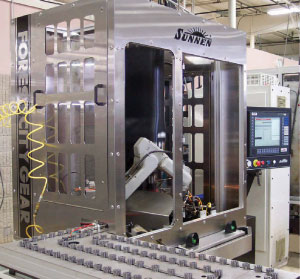 The automated part loading system, consisting of servo-robot and part handling machine, allows a wide variety of product sizes to be processed. Protective doors were removed from the front of the machine for photo purposes.
The capability of the newest automated CNC honing
systems meets today’s highest bore-sizing/finishing requirements,
producing hole size accuracies of 0.25µm (0.000010"), with minimal
variation and no operator intervention. The latest generation of
machines uses a patent-pending tool-feed system and can be equipped
with integrated post-process air gaging.
The combination of servo air gaging and
proprietary tool-feed control eliminates the need for an experienced
honing operator to tweak the process. The air gaging system permits
the highest possible accuracy for tool-feed control by taking
post-process measurements of parts while they are still fixtured on
the machine’s rotary table and making any necessary compensation in
the honing process (for bore diameter size or bore geometry).
In-process air gaging integrated in the honing
tool has been around for a few decades, but some operators fell it
is best used for automatic shut-off. The post-process system
produces the greater accuracy needed for tool-size control when
working to high Cpk standards. It eliminates measurement
uncertainties caused by an undersized or worn gage probe, which can
occur with a hone-head air gage.
It also allows measurement without interference
from the swarf and oil present during the process.
A typical application for this genre of machines
is a recent one involving production of spool valve parts for fluid
power equipment.
The hardened steel 56-59Rc part requires stock
removal of 0.0035", with final part specs of 0.00003" straightness,
0.00002" roundness, and a surface quality of 5µin Ra.
Varying wall thicknesses throughout the length of
the bore make this a challenging part. The fully automated honing
cell for these parts includes a six-axis robot, which takes parts
from a bowl feeder, inspects the incoming bore, aligns the part for
proper fixture loading, and places them in the honing fixture.
The three-spindle hone is tooled to remove
different amounts of stock at each station, after which the part is
air-gaged. After all three honing steps, the parts fall into a total
bore diameter range of 0.000125".
This type of servo-controlled hone knows the
exact location of the tool, how much it has been fed, etc. Some of
the older honing machines fed the tool based on force — the machine
sensed how hard it was pushing, but it didn’t "know" tool size at
any given time. These new machines do. A TurboHone multi-stone tool
or a diamond-plated CGT Krossgrinding tool can be adjusted for size
with a resolution of 0.25µm (0.000010"). The abrasive on these tools
enhances process stability, too, because wear is so little that the
tool may produce many parts before any compensation is needed.

Any operator with CNC experience will find these
machines familiar. The servo-controlled stroke system ensures a
consistent crosshatch pattern and can dwell in any part of the hole,
end-to-end, selectively removing stock for precise straightness and
roundness.
The machine can even make corrections that are
not intuitive for an operator. Switchable control features, such as
"correct for bore shape" allow the operator to select a "problem"
bore image, such as barrel or taper, and the machine will
automatically correct the part.
Combined with feedback from air gaging of
finished parts, this honing system can eliminate all of the
"operator’s art" from precision bore sizing and makes high-Cpk
holemaking the fully automated process today’s manufacturers often
want.
Sunnen Products Co.
Rich Moellenberg is custom products manager of Sunnen Products
Co.
What do you think?
Will the information in this article increase efficiency or
save time, money, or effort? Let us know by e-mail from our
website at
www.ToolingandProduction.com or e-mail the editor at
dseeds@nelsonpub.com.