July 2008 Edition
cutting tools & material strategies
Era of waste is over
Working smarter is more critical than ever to offset rising metal costs
By Peter B. Alpern, Associate Editor
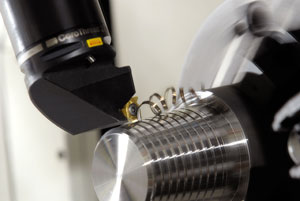 “I think the challenge for a lot of companies is to do the homework to find out exactly what piece you need for your process and invest in it.â€
— Dick Rohrer
While commodities such as gold and oil have hogged
the headlines — with a barrel of crude oil predicted to go to $150
this year — many of the lesser-known specialty metals are also
following suit.
That surge in costs for metals such as cobalt,
tungsten, tantalum, nickel, and beryllium has affected the price of
cutting tools throughout the manufacturing sector.
Though the cost for cutting tools and their
accompanying inserts hasn’t reached a critical stage, their
customers have been forced to consider with what innovative
techniques these tools can be best maximized.
"Everyone’s feeling the pain," says Michael
Locker, president of Locker Associates, a New York City-based steel
consulting firm. "Whether the Fed wants to admit it or not, we have
galloping inflation on the cost of production. And you’re really
feeling it in manufacturing."
There are many reasons for the cost increase:
metals from all over the map have leapt in price in recent years as
a result of the booming economies of China and India; the
manipulation of supply in several countries where these metals are
mined have affected the cost, along with the explosive growth of the
aerospace and medical implant industries.
Work more efficiently
Many manufacturers have been able to ride out the
tide by working more efficiently.
The days when a company could purchase strategic
metals plentifully and cheaply are gone. For years, the routine was
to use plenty of carbide to drill small, shallow holes. That was the
way it was purchased, and that was the way machining was done.
"You look back then — and we’re talking just a
few years ago — and they were often using pieces of carbide inserts
for both milling and turning," says Mike Gadzinski, Iscar Metals
national training manager. "It was way, way bigger than what they
really needed. We’ve all had to downsize what we’re using."
For a time, one of the smarter machining
strategies being bandied about was ways in which to extend tool
life. But Gadzinski doesn’t see that strategy as the end-all
solution.
"Nobody’s ever gone into business to save money —
they’ve gone in to make money," he says. "So if I can spend less
money on my inventory and material and do more work with a smaller
piece of carbide, and ultimately get more parts out the door, I’m
making more money."
Smarter machining
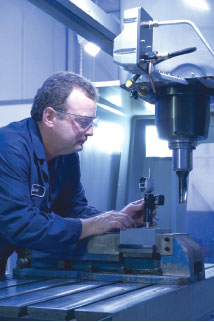 Inspection can show if a cutting tool shows wear.
For years, working more efficiently could be
loosely translated as relocating production to low-cost countries or
downsizing. But diminished production or a weaker product often
followed the immediate gratification of savings.
Cutting tool manufacturers have suggested that
the easiest way for customers to survive the upswing in metal costs
is through maximizing their productivity, improving their processes,
and reducing their waste.
Sandvik Coromant has formulated a model for
manufacturing economics, which draws on developments in advanced
tooling — educating the tool user on the physics of the equipment —
to achieve increased profitability in the global marketplace.
At the heart of the concept is the notion that
getting it right saves much more than getting it cheap.
"The way manufacturing economics works is if you
lower the purchase price of the tools by 30 percent, the customer
will save 1 percent of the cost of the component," says John
Israelsson, president of Sandvik Coromant USA.
"If he buys a better tool and increases tool life
by 50 percent, he lowers the cost of the component by 1 percent," he
notes. "But if instead he buys a better performing tool and speeds
up by increasing cutting data, he can reduce the cost of the
component by 15 percent."
Across the cutting tool industry — beyond the
brands and manufacturers — the emphasis has evolved. No longer can
materials be taken for granted or a machine simply be written off
and replaced. Cost and results are holding greater weight.
High-speed machines have helped lessen the blow of higher carbide costs. High-feed tool geometries facilitate chip thinning to improve performance, along with geometries that create cutting paths to use methods other than the traditional straight-line milling.
"Everyone has got to get smarter with how they’re
using their tools," says Gadzinski.
In some cases, that has meant working at higher
speeds, using a different kind of edge preparation on an EDM insert
or different form of natural depth cut.
As part of these strategies, high-speed machines
have helped lessen the blow of higher carbide costs. High-feed tool
geometries facilitate chip thinning to improve performance, along
with geometries that create cutting paths to use methods other than
the traditional straight-line milling approach.
A missing piece
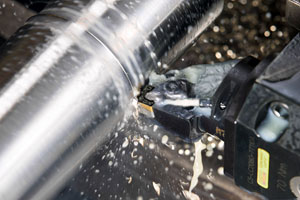 Cutting tool customers have been forced to consider with what innovative techniques these tools can be best maximized.
As a methods analyst for FL Smidth, Dick Rohrer
has watched the price for raw materials rise steadily for a decade
now. And he sees what’s happened to cutting tools — and just about
every industry that uses specialty metals.
FL Smidth builds kilns, hammer crushers, coal
mills, and stacking belt conveyers for the cement and mineral
industries.
"It doesn’t matter what brand or who’s selling
it," Rohrer says. "You can always figure 3 to 5 percent every year.
I’ve been buying tools for nine or 10 years now. And of late, it’s
really, really been jumping in price."
The spike has necessitated FL Smidth’s search for
better tools and more productive methods. Instead of focusing on
longer tool insert life, the company took a look at refining its
production methods.
Recently, FL Smidth increased the number of
valves it was able to produce from a steel plate from three to 30 —
all from switching to a high-quality carbide and working with
toolmaker Valenite LLC to refine its process.
"I think that’s the challenge for a lot of
companies," Rohrer says. "You’ve got to do the homework to find out
exactly what piece you need for your process and invest in it."
Maximizing every resource
Over the last three years, Absolute Precision of
Morrisville, VT, has watched its cost for carbide tools jump
approximately 33 percent, according to owner Matt Alley. One way
he’s tried to get around those costs is utilizing carbides only when
necessary.
"We switch to indexable tooling as much as we can
when we go to roughing," he says. "Our turning is all indexable.
There are a lot of submicron grades out there that are fantastic in
their wear properties."
Absolute Precision manufactures parts of complex
geometry, necessitating high accuracy. For Alley, cheap tools are
simply not an option.
"I’m sorry, but cheap tools do not cut it," he
says. "They do have their place in different markets. But, boy, as
far as I’m concerned, you need reliability. And the amazing thing is
so many people get scared away (by the cost of quality tools)."
Both Absolute Precision and FL Smidth utilize the
technical help that’s offered by tool manufacturers. Regardless of
whether a transmission shaft or a belt buckle is produced, the
underlying science of what happens when tool meets metal — and the
sometimes sizeable room for improvement there — is an exact science.
Namely, physics.
According to Bill Naill, materials manager for
Ingersoll Cutting Tools, while tool cost represents about 3 to 5
percent of the product value, if a customer learns how to optimize a
machine, it could bring in savings of 15 to 25 percent.
Naill says Ingersoll, like others industry-wide,
offers cost-cutting support to customers.
"We take a very active approach to salvaging
chips, and the carbide, and being much more aggressive and selling
them back to recyclers, to recoup some of the cost," he says. "Every
rock is turned over."
The days are gone when a tool could be ordered
and a machinist could experiment with it to determine what works
best, Alley laments.
"You can’t do it," he says. "There are too many
different parameters. When you can call a toll-free number and get
the exact answer you want, that’s worth its weight in gold."
Supplies tighten, demand soars
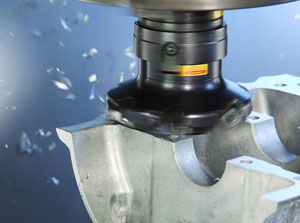 Tungsten has long been considered a strategic metal due to its use in cemented carbide parts for wear resistant applications such as drilling, mining, and metalworking.
The two metals most closely associated with
cutting tools are tungsten and cobalt. Tungsten is combined with
carbon into a crystal, creating tungsten carbide (WC), which is then
mixed with cobalt as a binder. Carbide leaves a better finish on the
part, allowing for faster machining, while withstanding higher
temperatures than standard high-speed steel tools.
These days, cobalt has been one of the most
difficult metals to procure.
"That’s the one that’s giving us fits," says
David Landsperger, director of metallurgical operations at
Kennametal Inc.
Statistics show only 10 percent of the world’s
supply of cobalt is used in cutting tools. But recently, cobalt’s
price has skyrocketed. Since last August, it’s jumped roughly 100
percent and is now inching toward $50 per pound.
Cobalt is most often sought for use in jet
engines, turbine blades, rechargeable batteries (including those
used in hybrid vehicles), and solar panels.
Cobalt mining has had a long history of
turbulence in supply due to the geopolitical climate of the
Democratic Republic of Congo and Zambia, where much of it is found.
It is also found in Australia and Canada.
Equally important has been the concentration of
cobalt producers in recent years.
"If supply and demand are in close balance,"
Landsperger says, "it’s not difficult to move the market one way or
another if you’re a trading house with deep pockets."
China’s chokehold
Tungsten, compared to cobalt, would appear to be
the far more stable metal … except history suggests that it’s
anything but.
Tungsten is best known for its use in light bulb
filaments. It has long been considered a strategic metal due to its
use in cemented carbide parts for wear resistant applications such
as drilling, mining, and metalworking. It is also critical in the
manufacture of jet engines, the production of super-alloys, and
armor-piercing ammunition.
China has a virtual chokehold on the world’s
access to tungsten. It holds approximately 85 percent of the world’s
mine production of tungsten ore within its borders, and 65 percent
of the world’s reserve base.
Cutting tool manufacturers have suggested that the easiest way for customers to survive the upswing in metal costs is through maximizing their productivity, improving their processes, and reducing their waste.
An independent study by specialist metal
marketing consultants GBRM Ltd. estimates that through 2012, the
annual consumption of tungsten is expected to increase from 81,200
tons to 109,328 tons, thereby requiring almost 22,000 tons a year of
new production.
While there has been a significant increase in
exploration and mine development outside of China in recent years,
no major new production has been realized and isn’t predicted to
occur until 2009, according to the GBRM study.
Meanwhile, China has not only curtailed its
domestic mining programs, but has actually become a significant
importer of tungsten concentrates and scrap.
All of which drives home just how small a
quantity of material the world is working with.
Landsperger says he calculated once that the
tungsten ore the world consumed in a year was equal to the amount of
iron ore produced in two minutes.
"That should give you an idea of just how much
these are niche materials," he says. "And cobalt consumption is a
little bit less than tungsten."
Price fluctuations
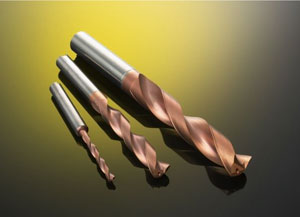 Carbide drills are a staple of the metalworking industry.
The whims of the raw materials market are, by
nature, turbulent. But even Ingersoll’s Naill is stunned at what
he’s witnessed in recent years.
"I’m not sure I’ll ever see the prices that I was
getting two or three years ago for material," he says. "What was 52
to 59 cents a pound is up to $1.40 to $1.50 a pound. And that’s even
before heat treatment [which adds even more cost, due to the energy
used]."
The fear of losing loyal customers is another
consideration that comes with higher costs of materials.
"We have seen examples where the supplier is able
to pass on perhaps a 5-percent increase out of a 50-percent jump in
his own input prices," says Anders Rune, chief economist at the
Association of Swedish Engineering Industries. "And smaller players
are usually less able to secure beneficial raw material prices by
using forwarding contracts."
The extra cost is often shifted down the "food
chain," from the manufacturer, to second and third-tier suppliers —
those that are furthest removed from the end user — all the way down
to the customer.
"[The rise in costs] makes us think wiser and try different
things and experiment a lot more," says FL Smidth’s Rohrer. "You try
to look around for people that are willing to invest a little time
and improve the process."
Iscar Metals
Sandvik Coromant
FL Smidth
Ingersoll Cutting Tools
GBRM Ltd.
Association of Swedish Engineering Industries;
Locker and Associates
Kennametal Inc.
Valenite LLC
What do you think?
Will the information in this article increase efficiency or
save time, money, or effort? Let us know by e-mail from our
website at
www.ToolingandProduction.com or e-mail the editor at
dseeds@nelsonpub.com.