January 2008 Edition
edm
Makino EDM webinar aims for aerospace manufacturers
By Dennis Seeds
Jeff Kiszonas, EDM product line manager for Makino Inc.,
hopes the webinar he presents on Jan. 17 will enlighten some
in the aerospace industry. He will discuss the results of
new tests by Makino at a Nadcap-certified, independent
laboratory: the new generation of EDM machines don't damage
surfaces like they used to – and get parts made faster and
cheaper.
"It's really just to open the eyes of some people in the
aerospace industry to say, 'Hey, guys, you really need to
reconsider your old specifications for this process. Look at
what the new machines are capable of.' "
The presentation is part two of a webinar on the subject.
The first part was given last July and is available online
at www.makino.com. Kiszonas also hopes to present his
findings at a Society of Manufacturing Engineers event in
Toronto this May.
Several aerospace manufacturers, including Lockheed
Martin Aeronautics, have recently performed extensive
testing of parts made by EDM to determine if the process is
effective and economical.
The general assessment among EMO exhibitors
was very positive. More than two-thirds of them say
they were more than satisfied with the run of the
show. Exhibitors could reach all their key
industrial target groups, especially automotive
manufacturers and subcontractors, the
mechanical-engineering industry, and the entire
spectrum of metalworking and metal processing.
Makino went a step further to get more specific results.
It tested 18 samples of three different aerospace alloys: Ti
6-4 titanium, 17-4 PH stainless steel, and 6061-T6 aluminum.
"What we found out, in the old days 30-40 years ago, EDM
would leave anywhere from two to six thousands thickness of
heat-affected zone [HAZ] that would contain micro-cracks,
recast layer and annealed layer," Kiszonas notes.
"The EDM process today leaves no HAZ, and recast is down
to less than .0004"," he says. "Micro-cracks are almost
non-existent. Modern EDMs can produce parts with finishes
down to 0.5micron Ry, tolerances in the submicron range, and
leave the surface of any part with virtually no damage.
"The needs of manufacturing are driving EDM builders to
develop machines that will maintain extreme accuracy while
completing jobs faster. Useable wire diameters are down to
0.0008", Fine Hole drilling machines have produced clean,
accurate holes of 22 micron diameter, and some builders
offer customized machines for specific needs."
For the testing, conducted at IMP Test Labs of Lansing,
NY, the samples were produced on Makino EDNC43S RAM EDM and
SP43 Wire EDM machines using various electrode and wire
materials.
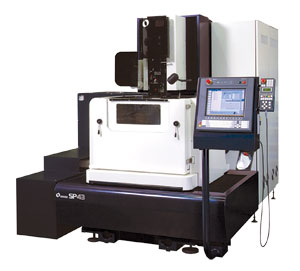 The SP43 machine, used in the test, is an extremely fast
wire-cutting machine, able to hold tolerances of ±5 microns.
The unit can be used for many diverse applications, from
tall workpieces to precision small holes.
The SP43 machine, used in the test, is an extremely fast
wire-cutting machine, able to hold tolerances of ±5 microns.
The unit can be used for many diverse applications, from
tall workpieces to precision small holes.
However, the webinar will not focus on any particular
machine, Kiszonas says. Lockheed's testing concluded that
all major manufacturers' machines today obtain similar
results. Makino's machines were slightly better – but only
by a difference of millionths of an inch.
"So as a general statement, all EDM machines today of the
major players do not damage the material surface like they
used to," Kiszonas notes.
The improvements made over the generation of machines are
largely due to the development and evolution of the
generators.
"I cover this in both parts of the webinar. The older
generators were DC generators. They had very limited
adaptive control ability, if any. They were using a lot of
the RC circuitry, whereas today's machines are using AC
generators with highly adaptive gap control circuits to
prevent damage to the parts. They're also using high-speed
switching transistors to develop the spark instead of the
old RC circuits. Those items all combined among other
things, like anti-electrolysis circuitry and such, have
taken us from that four to six thousands-thick damaged area
to virtually no damaged area," Kiszonas says.
He anticipates a good turnout for the webinar. Whether
the industry is receptive to the suggestions may be a matter
of individual choice, he notes: "A lot of people are open to
it, a lot aren't. The biggest resistance may be from the
older engineers who are of the mindset, 'If it ain't broke,
I'm not going to fix it' and also guys that just don't want
to make a commitment to make a change that could affect
people's lives. When you are talking about engines for an
aircraft, or wings and fuselage components, or landing gear
structure, guys say, "Hey, it's been working all these
years. I'm not going to take the risk of changing and have a
plane fail.' "
But on the other hand, some of the newer engineers who
will be replacing those who retire see the need to make
changes and they understand they need to re-evaluate some of
these technologies, he adds. Makino Inc.,
www.rsleads.com/801tp-190
To register for the webinar, go to
www.makino.com/about/shows_events/default.aspx
Dennis Seeds is senior editor of Tooling & Production
magazine.
What do you think?
Will the information in this article increase
efficiency or save time, money, or effort? Let us know by
e-mail from our website at
www.ToolingandProduction.com or e-mail the editor at
dseeds@nelsonpub.com.