February 2008 Edition
medical manufacturing
Company makes precise cuts so surgeons can do the same
The tools used during surgical procedures must be highly precise. No flaws and no failures.
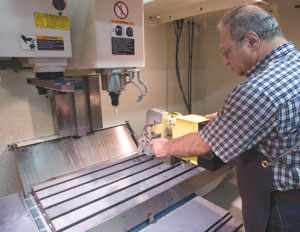 A technician sets up parts on a MAG Fadal VMC 4020. Spec Engineering has 10 VMC 4020 machines in operation on its shop floor.
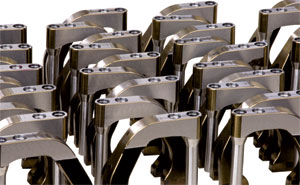 These stainless steel surgical alignment fixtures were machined at Spec Engineering on MAG Fadal VMC 4020 machining centers.
For the past 20 years, Gregory Viksman has made a successful business out of producing stainless steel, titanium, and plastic surgical instruments for the medical device industry. His company, Spec Engineering, Van Nuys, CA, machines delicate, intricate pieces, taking raw material to precision finished parts with machine surface finishes of 32 to 40 Ra.
Materials range from soft 303 stainless steel to hard 465 Custom. Like PH 13-8 stainless steel, 465 Custom is not easy to machine. The parts are designed with complicated geometry, and positional tolerances are typically in the range of +/- 0.002" (0.05mm) true position, with hole size tolerances of +/0.0003" (0.008mm).
Spec Engineering also machines special plastics for radiolucent transparent alignment fixtures used to position drills and other tools used during surgery. These fixtures are made out of high-performance polymers such as the glass-reinforced Ultem 2300, and carbon fiber reinforced PEEK. Both are very abrasive and require the use of diamond-coated or diamond-insert cutters.
In terms of machining-center capability, the company has standardized on MAG Fadal vertical machining centers, with 10 VMC 4020 machines currently in operation on the Spec Engineering floor. The 48" (1,219mm) x 20" (508mm) table size of the 4020s provides the space to fixture 10 to 20 parts in one setup. Some parts are set up in multiples in a vise.
Cutting titanium
"The Fadal 4020s have the rigidity and capability needed to machine titanium, while holding the dimensional tolerances and surface finish quality our customers need," says Viksman. "We are using Fadal VH 165 fourth-axis rotary tables on some of the 4020s, and have a setup for five-axis machining using TR 165."
Axis positioning accuracy on the MAG Fadal VMC 4020 is +/- 0.0002" (+/- 0.0050mm), with repeatability of +/-0 .0001" (+/- 0.0025mm).
Spec Engineering’s machines are equipped with a 10,000rpm coolant-thru spindle for high-speed machining, with the rigid tapping option. Cutting feed rates are up to 600ipm (15.24mpm) with rapid traverse of 900ipm (22.86mpm) in the X and Y axes. A 21-tool automatic tool changer serves the various machining processes. MAG Fadal also produces an FX series of machines that increases the cutting feed rate of the VMC 4020 to 800ipm (20.32mpm), with rapid traverse of 1000ipm (25.4mpm).
Challenges
Batch sizes at Spec Engineering range from 25 to 300 or more, with a typical production run being approximately 100 pieces. Part programs are developed offline and downloaded to the machine controls. Spec Engineering’s capabilities are rounded out with a Hardinge turning center and Star Swiss screw machines.
What is the most challenging type of part that the company tackles? Viksman says: "Medical drill guides and guide drops. We machine holes in two different planes on the part, and these features require extremely close tolerance work. Hole diameter tolerances are typically +/-0.0002. The thru-position projection tolerance may be +/- 0.003" over 4.25"."
The work may not be easy, but doing it well is important. Successful surgery depends on the precision of the instruments as well as the doctor's skill. Maintaining critical accuracies has paid off for Spec Engineering in terms of the continued business relationship with its medical instrument-producing customers.
"The Fadal machining centers are the right machine at the right price for our type of work," Viksman says. "We are able to reinvest profits back into our operation, expanding our number of machining centers, which allows us to increase our capabilities and take on diverse projects at the same time."
A new emphasis on minimally invasive surgical procedures has hastened the development of more intricate instruments, requiring specialists to produce them. The medical device industry in general, and precision machining work in California in particular, have been in a growth mode. Operations that have invested in the right level of metalworking technology are reaping the benefits of a region that is also rich with die and mold machining and prototype work, as well as production parts manufacturing for the aircraft/aerospace, automotive, and other industries. MAG Fadal
What do you think?
Will the information in this article increase efficiency or save time, money, or effort? Let us know by e-mail from our website at
www.ToolingandProduction.com or e-mail the editor at
dseeds@nelsonpub.com.