April 2008 Edition
production strategies
More BMWs to hail from SC
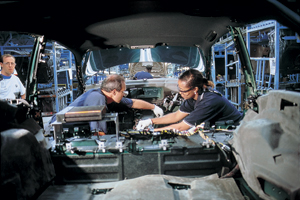 BMW'
s Spartanburg operation was modernized recently without any interruption to production. This was completed in the less active time between Christmas and early January.
BMW'
s Spartanburg operation was modernized recently without any interruption to production. This was completed in the less active time between Christmas and early January.
German automaker plans $750 million Spartanburg expansion
The automotive industry in America is prospering, one could say, compliments of foreign automakers.
Take for example:
- Toyota has announced it will build a $1.3 billion
manufacturing plant near Tupelo, MS. Some 150,000 Highlander crossover
utility vehicles will be produced annually when the facility opens in 2010.
- Kia has broken ground on a new $1 billion plant in
Georgia expected to open in late 2009 with an annual capacity of 300,000
vehicles.
- Since October 2006, Honda has announced plans for $91
million in additional construction and investment at its Lincoln, AL,
facility.
- Mercedes-Benz is considering a $5 million expansion to
its Ann Arbor, MI, emissions laboratory to help develop cars for the United
States market.
The additional investment will prepare the factory to increase production from 160,000 units to 240,000 units. The expansion also means a bigger purchase and export volume in and from the NAFTA region.
Add to that BMW's recent plans to invest an additional $750
million to its Spartanburg, SC, operations. This will include adding 1.5 million
sq ft to the site to produce three models. Production capacity is expected to be
240,000 units by 2012.
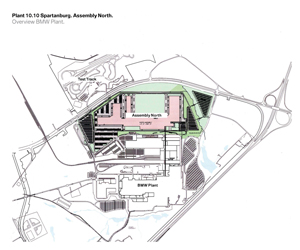 The Spartanburg plant expansion will be north of the current operations.
The three-year construction project includes a
new 1.2 million-sqft assembly facility north of the existing factory
to accommodate the next generation BMW X3 Sports Activity Vehicle.
In addition, the paint shop will expand by about 80 percent or
300,000sqft. The existing body shops will be renovated.
"This is another positive sign that our efforts
to improve the state's business climate are paying incredible
dividends," says Gov. Mark Sanford. "BMW's announcement to expand
its operations in South Carolina is far more than an expansion.
"This investment brings with it an entire second
production facility that will significantly impact the growth of our
state's automotive industry not just in terms of the jobs directly
tied to the investment, but also indirectly from the new jobs and
investments expected to be generated by BMW suppliers."
South Carolina Secretary of Commerce Joe Taylor
echoed those comments, saying the new plant means new jobs for
people and many new supplier jobs all over South Carolina.
BMW said it plans to add 500 jobs in Spartanburg,
but to cut 5,000 jobs in Germany and 600 elsewhere, or 7.5 percent
of its work force over two years.
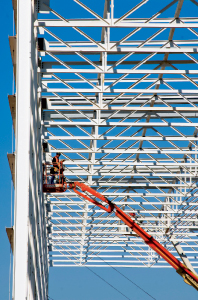 The three-year construction project now under way includes a new 1.2 million-sqft assembly facility.
A BMW spokesman said the rising value of the euro
against the dollar does play a part, but it's not the primary reason
for the expansion. A rising euro means European goods cost more for
Americans to buy. One industry analyst said by building the cars in
the United States, BMW could save money on the lower dollar and on
wages since its South Carolina workers make less than German
workers.
The additional investment will prepare the
factory to increase production from 160,000 units to 240,000 units.
The expansion also means a bigger purchase and export volume in and
from the NAFTA region, which will contribute considerably to the
company's natural hedging position.
"Centralizing our know-how for BMW X models in
Spartanburg will enable us to work more efficiently, thus supporting
our long-range corporate strategy," says BMW board member
Frank-Peter Arndt. "In addition, it was a logical step for the BMW
Group as a global player to increase production capacity in its
largest market."
According to Arndt, the company will add a new
generation of its four-wheel drive sport utility vehicle, the X3, to
the site. It would then become the exclusive source for the X3 and
X5 Sports Activity Vehicles, and the X6 Sports Activity Coupe.
Earlier this year, the X6 sports coupe was unveiled at the Detroit
Auto Show.
A highlight will be the production of a diesel X5
Sports Activity Vehicle for the U.S. market later this year.
"The boost in the production capacity at BMW
Manufacturing will positively impact the logistics, supplier and
distribution networks that support the manufacturing processes,"
says Josef Kerscher, president of BMW Manufacturing. While the
supplier network may grow, existing supplier companies will ramp up
operations to provide automotive parts for the higher production
levels, doubling parts container traffic and significantly
increasing exports through the Port of Charleston.
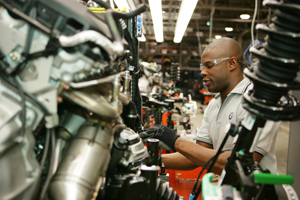 The Spartanburg factory retrofit was one of the largest conversion/upgrade projects achieved in the American auto industry.
When BMW Group announced in 1992 that it would
build its first full manufacturing facility outside of Germany in
South Carolina, the company pledged to invest $600 million, to
employ 2,000 workers by the year 2000, and attract at least nine
suppliers to the state.
By the year 2000, BMW had grown to more than 3,000 BMW
workers and by 2004 that number grew to more than 4,600. Within that same time
period, BMW began to employ contract workers to primarily provide specialty and
administrative services.
As BMW entered 2008, the number of on-site workforce,
including BMW associates and contract workers, grew to more than 5,400 with a
total payroll of more than $450 million annually. In addition, BMW has a
contingency workforce of about 900 workers with an average annual payroll of
more than $50 million.
BMW currently has invested $3.5 billion in its South Carolina
operations, and more than 5,400 people work on the site. Fifty-two suppliers are
located in South Carolina, and 40 of those 52 suppliers have chosen to place new
North American operations in the state to partner with BMW. BMW's North American
supplier network has grown from 22 in 1992 to 194 companies today.
To meet growing customer demand, vehicle production at BMW
Manufacturing has grown from 429 units in 1994, which was the first year of
production to 157,530 units in 2007. In the same period the sales volume in the
United States increased from 65,000 to 335,000 units in 2007.
BMW AG
BMW-Siemens project takes only 3 months
In the most recent of many joint projects, Siemens and BMW
have converted the automaker'
s existing Spartanburg, SC, plant into a
state-of-the-art facility — within a three-month time period.
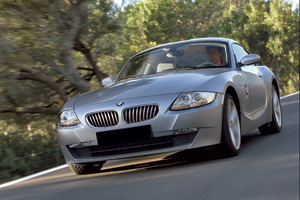 More than 150,000 BMW Roadster Z4 (pictured) and SAV X5 models are produced annually at the Spartanburg facility.
Siemens implemented seven key solutions in the final assembly
operations, from the joining of the chassis and the engine through different
conveyor systems and the complete automation system for the plant.
Production of the 3 Series BMW began at the South Carolina
site some 13 years ago. Today, the facility's 4,500 employees produce more than
150,000 of the BMW Roadster Z4 and the SUV model X5 there annually. BMW decided
to extend the production to include other models, without increasing the factory
floor space. This project required extensive conversions, including the
replacement and enhancement of nearly half the existing systems.
Siemens acted as general contractor for seven projects and as
a subcontractor in another three units. The two-line assembly system was
converted into a one-line system. At the same time, it was enhanced with the
latest manufacturing technologies. The X5 and the Z4 are now assembled there in
all three models including the Roadster, Coupé and M.
Trouble-free collaboration
One of the most interesting subprojects was a marriage of 10
stations with one automatic assembly station and one automatic nut-running
station. This creates a previously unknown precision and eliminates the
non-ergonomic overhead work that had to be performed in the production area.
Twenty-two Inductive BTS vehicles with the prepared chassis
components with separate assembly racks are in operation in the new system.
Another important task was the modernization of several
conveyor systems. For this work, a completely new skid system with 81 skids was
installed. Another 300-meter long skid system was converted.
Additionally, a 150-meter long chain conveyor system, as well
as a heavy load conveyor with a total of 91 suspension tackles, was installed.
Altogether, new conveyor systems with a total length of 6km were installed. All
systems including the EMS drivers were equipped with Siemens Simatic controllers
(PLC).
Automation system
The factory's totally new automation system now
complies with the international BMW standard, which was implemented
for the first time at the BMW factory in Munich, Germany.
A substantial amount of hardware and software was
installed to achieve this result at the Spartanburg facility. Twenty
programmable logic controllers of the Simatic S7-400 type and seven
S7-400F controllers form the nucleus of the new automation system.
Approximately 200 IM 151-F-CPU modules were also
installed. Throughout the factory, 2,000 drives, 45,000 I/O devices,
and 240 switch cabinets were installed to communicate via more than
400,000m of cable. This facilitates the smooth interaction of all
systems and a trouble-free production process. Seventy-five MP 370
operator panels and 121 Simatic OP 77B panels provide the HMI.
Minimum downtime
The Spartanburg project had a special challenge:
The whole conversion had to be organized and completed within a
three months — with as little interference as possible while
production was maintained.
The first partial shutdown of production was not
made until nearly two-thirds of the project had been completed. It
lasted less than six weeks. The remaining production was shut down
just prior to completion of the project, and the shutdown continued
for less than three weeks.
Delivery stoppages were therefore limited to only
a few days plantwide. The use of the digital factory (pilot plant)
during design for critical units such as the marriage helped reduce
risks early. All crucial mechanical and automation technology
components were set up and rigorously tested in an 8,000sqm test
facility before installation. The fully functional systems were then
transferred to the production facility in the few weeks available.
They were then integrated in the overall system.
About half the entire operation was modernized in
just five weeks, without any interruption to production. The rest
had to be completed in the three remaining weeks, which also fell in
the less active time between Christmas and early January.
The cooperation between BMW and Siemens was no
coincidence. Siemens had already proven its ability to successfully
execute complex projects within a tight schedule, through its
involvement in earlier conversions at BMW's German factories in
Dingolfing and Munich.
Siemens became involved in the Spartanburg project during its
preliminary planning stages. The factory was one of the largest
conversion/upgrade projects achieved in the American auto industry.
The personnel deployment was also appropriately large, including
Siemens employees from its Atlanta and Detroit locations, as well as
specialists from numerous German facilities of Siemens.
Siemens Energy and Automation
What do you think?
Will the information in this article increase efficiency or
save time, money, or effort? Let us know by e-mail from our
website at
www.ToolingandProduction.com or e-mail the editor at
dseeds@nelsonpub.com.