October 2007 Edition
turnkey strategies
High-speed machining lets rapid proto go even faster
ETCO Incorporated, founded in 1947 as Electric Terminal Corporation, originally produced wall-plug blades in strip form for attachment by the customer on a patented air-operated machine. ETCO still produces wall-plug blades — although the production speeds have increased from 175ppm to as fast as 3,000ppm. Last year, the Bradenton, FL, company produced approximately half of all wall-plug blades made in the United States. Additionally, ETCO's "tried-and-true" product line is constantly added to. Its offerings include thousands of different products — including catalog and custom-designed products tooled to customer's needs. Through rigorous R&D, ETCO's patented and proprietary products represent approximately half its annual sales.
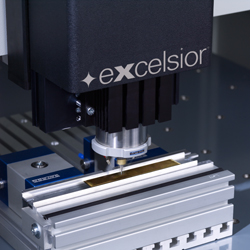 |
| ETCO uses a Datron Excelsior high-speed CNC machining center for the rapid prototyping revolutionary electrical connectors. |
While plug blades remain big business for ETCO, Chairman David Dunn looks to the future — insisting that innovation and patented, cutting-edge technology will ensure his company's place there. To that end, ETCO is virtually a think tank dedicated to continuous R&D. Two of the key players in Florida are Ralph Jacques, director of research and development, and his brother Edward, manager of research and development. With Ralph's strength in manufacturing and production management and Ed's years of experience as a tool and die maker, and process automation, they represent a great R&D one-two punch for ETCO.
Several years ago, the R&D team identified some problems that impacted overall R&D efficiency and time-to-market. Specifically, the prototyping process often required subcontractors and, at times, up to 20 rounds of modifications to initial designs. With a two- to three-week turn around from some of their specialty vendors and a common policy for minimum quantity orders, this was simply too time consuming and expensive. In 2005, the R&D team set out to make some changes — focused on bringing subcontracted work in house via the installation of a precision CNC machining center capable of quickly producing small, intricate electronics parts.
"We knew that our proprietary designs were advancing the company in leaps and bounds, and also understood that having R&D agility called for equipment that could quickly leverage the full power of our design concepts," Ralph explains.
After researching five or six different machine tool manufacturers, ETCO ultimately decided to pay a visit to Datron Dynamics Inc. in Milford, NH. This North American distributor for Datron in Germany offers a line of high-speed machining centers designed around 60,000rpm high-frequency spindles.
R&D demands
During a visit at Datron, Ralph conveyed his equipment criteria as follows:
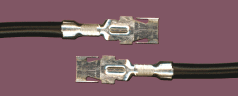 |
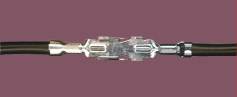
| FlatSnap — making the connection with pull-on/push-off ease-of-use. |
 |
-
To design, manufacture, and test a prototype concept the same day in-house at ETCO;
- To reduce costs and have quick pay back on equipment investment;
- To employ a user-friendly machine and software that did not require extensive cost and training;
- To apply a turnkey solution that includes tooling and workholding for very difficult small parts; and
- To leverage more in-house control of design, testing, and initial production runs...in a short time.
The machine tool builder was able to demonstrate something to Ralph that none of the other CNC vendors could — namely, that turnkey solution. This included software for design, CAM to generate toolpath, a CNC machine to mill the part, workholding to hold the part, and micro-tooling to cut the part.
"When Ralph came back from New Hampshire," Ed recalls, "it was a done deal. He was convinced that this was the most impressive technology and said that the German engineering was rock-solid quality through and through."
ETCO purchased this packaged solution from Datron Dynamics and quickly found out just how "rapid" its prototyping could be. According to ETCO, using the Datron saves it time, since proprietary ideas developed in-house eliminate the time and cost associated with getting signed disclosures and sending prototypes back and forth with subcontracted manufacturers.
"Now, we conduct review meetings to explore all design concepts submitted for new connectors," Ed says. "We discuss the pros and cons of a given concept and if we like it, we leave the meeting, draw it up in SolidWorks or PrimCAM, mill the flat blank out on the Datron, and within hours of the meeting we have a working prototype which is goes through simulated UL testing the very same day."
Case in point
A revolutionary connector recently patented by ETCO perhaps best illustrates the value of keeping this proprietary work in-house. While most connectors are comprised of male and female parts that fit together to make an electronic connection, this connector is classified as a hermaphroditic adapter, in which the design allows for the connection to be made with two units of the exact same part — thereby eliminating the need to maintain an inventory of both male and female connectors.
It's such a logical and simple solution that it's hard to believe that it has never been done before. But when you consider that it took ETCO 10 design changes from the initial concept to the final prototype, it's understandable that companies without a Datron machine simply couldn't afford the time associated with this extensive R&D.
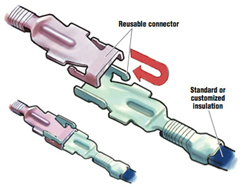 |
| Changing electronic components used to require cutting wires and recrimping them. But, ETCO used a Datron high-speed machining center to produce the prototype for their patented FlatSnap connectors. The connectors are reusable and make a solid pull-on/push-off electrical connection that resists coming apart. They can be used on appliances, scientific and medical devices, stereo equipment, and automotive and marine electronics. The connectors can also be used to form a splice. |
"With the Datron, it was a very exciting process," says Ed. "We would test the design at the end of each day, make modifications the next day, form, crimp, and test again that afternoon." In the end, what would have been weeks of trial for ETCO (and perhaps months for companies with less efficient or skilled R&D groups) became hours because of the speed and agility of the Datron machine. One of the factors that makes Datron technology so agile is its user-friendly Microsoft Windows-based control software and it's ability to interface with most CAD/CAM packages like the PrimCAM package used by ETCO for rapid prototyping. The Datron control delivers information in a familiar and intuitive Microsoft environment. Also, operators can view or edit programs during machining, run other software simultaneously as the machine is milling, or download large files through a company network. Plus, they can remotely diagnose the machine or monitor the machine's activity through a standard Internet connection. Because it is user-friendly, easy to learn, robust, and integrates with PrimCAM so nicely, it immediately empowered ETCO — providing it with a platform capable of transforming an idea on a napkin to a completed part quickly and cost-effectively.
"This Datron machine," Ralph notes, "gives you the ability to see what you saw in your head, placed in your hand within six hours...pretty cool!"
While designing ETCO prototypes begins in the software, not all of ETCO's new-found prototyping efficiency is software related. Indeed, proof is in the pudding and new designs can't be tested until a physical part is produced. Where these small, intricate brass connectors are concerned, the high-speed technology of the Datron machine certainly fits the bill. With microtooling (1/4" and under) the 60,000rpm spindle reduces the chip load to less than 0.005". Such a low chip load significantly reduces the forces between the tool and the material. This high-speed/low-force machining yields less heat, reduces tool deflection, and allows machining of thinner walled workpieces. This all results in cooler machining, superior surface and edge quality, and better accuracy. Additionally, with the non-ferrous metals and plastics used by ETCO in prototyping, the ethanol-mist coolant system on this Datron model produces superior cooling and eliminates the secondary operation of degreasing. Here's how it works. A small tool with intricate geometry turning at an extremely high rpm calls for a cooling and lubricating agent with a lower viscosity than water. Lower viscosity is needed because the coolant needs to make it to the cutting edge of the tool despite the high spindle speeds involved. Emulsion-based coolants have a higher viscosity than water, and thus are ineffective as a lubricant for high-speed machining with micro tooling. But ETCO's Datron system uses micro-volume ethanol spray. Ethanol is a form of alcohol that occurs naturally in the sugar-fermentation process and exhibits a lower-than-water viscosity. The low-evaporation point of ethanol makes it an extremely efficient cooling and lubricating agent for high-speed machining operations. And while conventional flood coolant is petroleum based and needs to be properly disposed of, ethanol simply evaporates. This eliminates the costs associated with disposal. In addition, ethanol as a coolant does not leave any residue on the machined parts, thus eliminating the costly secondary operation of degreasing parts.
Marveling at the changes realized through the addition of the Datron, Ed says: "When developing a prototype you may find you are a thousandth off and you have to do it again. This machine is small, fast, and clean — in other words, it's perfect for a rapid prototyping environment."
Datron Dynamics Inc.,
www.rsleads.com/710tp-153
Help other readers advance their know-how by sending your feedback on this article to
Tooling@ToolingAndProduction.com.