October 2007 Edition
corrosion protection
'Green' inhibits the corrosion and ups customer satisfaction as well as fewer tool wrecks
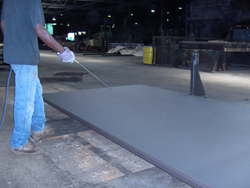 |
| Spraying down a plate with Picoguard 17625 |
The Gateway Company, home-based in St. Louis, MO, is a major corporation specializing in metal services such as structural steel fabrication, blast cleaning steel forms, and field painting. Its many customers include construction companies and off-the-road equipment manufacturers.
One of its subsidiaries is The Gateway Co. of Illinois in Joliet, IL (aka Gateway-Joliet), a 500,000-sq-ft facility established for specific client needs. This plant receives, warehouses, abrasive blast cleans, and reships carbon steel plates, forms, and parts used in construction equipment and assembly. The facility is built around two automatic roller steel shot blasting machines with abrasive recovery and full dust collection. Gateway-Joliet was created for a just-in-time delivery system serving a Caterpillar assembly plant as well as providing shot-blast services to various steel service centers. The plant also utilizes a state-of-the art inventory tracking system for its customers.
Gateway Joliet employs a plate roller-conveyor machine that processes 123"x10"x70' sections and another unit for parts 102"x20" and up to 70' long. Parts, plates, and sheets done one at a time can range in weight from 1lb to 30,000lb. Blasted sheets are stacked up to 24" high and may be banded for shipments that can weigh up to 40,000lb.
| Inhibitor Type |
Advantages |
Disadvantages |
| Oil |
Used as received; very popular type in the steel industry; excellent corrosion protection; very high flash point; easy to apply; can reject humidity and condensation; low VOCs. |
Can drip off steel shapes; high costs due to quantity consumed, may have to be heated during application; may contain heavy metals such as barium; will produce smoke during welding; may cause welding porosity; can interfere with machining coolants; high probability will interfere with paint adhesion unless thoroughly cleaned off. |
| Solvent |
Used as received; easy to apply; will tend to leave a dry film; water repellent film; excellent long-term corrosion protection; appropriate additive system will not interfere with welding; some paint and primer coatings can be applied without cleaning. |
Lower flash point than oil; has VOC content; may contain heavy metals such as barium; may have objectionable odors; may be difficult to detect on coated surfaces; may have to be cleaned before coating. |
| Water-soluble oil |
Easy to apply; no flash point or fire safety issues; possible to use a pre-mixed version; good rust protection; low VOC content. |
Usually diluted with water before application; mixing with water has to be done carefully and with pure water; oil residue may interfere with welding and coating adhesion; may interfere with machining coolants; direct exposure to water vapor will tend to wash off coating and cause rust; not as good corrosion protection as other two types. |
In addition to sheet and plate processing, Gateway-Joliet processes bars, structural members, castings, and piece parts other than those with machined surfaces. The blasting process will remove rust, scale, coatings, and heavy waxy corrosion inhibitor films. The facility also leases some of its warehouse space for its customers.
Protection issue
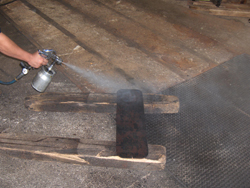 |
Spraying down a piece part
with Picoguard 17625 |
Blasted steel surfaces need to have a corrosion inhibitor applied so that the "sensitized" cleaned surface will not rust. Many types of protective inhibitor coatings have certain advantages and disadvantages for either a blast-cleaning service center or its customers. Gateway-Joliet had used various types of corrosion inhibitors including oil, solvent, and water-soluble oil types depending on customer requirements and specifications. The advantages and disadvantages of these inhibitors are shown in the table to the left.
Gateway-Joliet originally chose and settled on a ready-to-apply soluble oil as its standard coating — primarily because it was easy to use, had very low odor, exhibited no flash point, and could easily be applied by manual wand sprays. However, company leadership was not satisfied because they wanted to improve the blasted and cleaned surfaces for its customers by applying a coating without oil that was more environmentally friendly. They turned to PICO Chemical Corp. of Chicago Hts., IL, because of PICO's years of experience in steel mill and service center applications and because PICO is widely respected for its environmentally-friendly (green) products.
The solution
William (Bill) Bell, Gateway-Joliet's vice president — general manger and Richard (Rich) Workman, assistant plant manager, were presented with Picoguard 17625, a new generation corrosion inhibitor that offers PICO's modern technology to eliminate the disadvantages of oil containing fluids. Picoguard 17625 was accepted for trial and customer approval because it can be conveniently used as received — no worry that plant personnel may err in any mixing process. This new technology fluid contains no oil, heavy metals, solvents, or environmentally objectionable ingredients. Some of Gateway's customers such as John Deere publish a restricted list of chemicals and substances that they will not allow into their plant even on coated steel forms — Picoguard 17625 passed all chemical content hurdles including EPA regulations — offering exceptional corrosion resistance even without forced air-drying. It also has proven its value for other metalworking firms that dilute it with water for lesser applications than the one demanded by Gateway-Joliet.
"For us, the best term to describe Picoguard 17625 is consistency — safe and trouble-free application — and for our customers it's total process acceptability and quality results," says Bell.
Because Picoguard 17625 is used as received directly from its container no fluid controls are required. During the winter months a drum belt heater is used to keep it from freezing by maintaining product temperature between 50° to 100° F. The workers who apply it with a spray wand find it has virtually little or no odor and they can see where it has been coated before it dries off — minimizing over spraying. Flat-stacked steel pieces do not stain or stick from having the fluid in between after a lengthy truck shipment and customer storage hold for processing. There is no drippage on to the floor because of its very light viscosity.
| Product |
Type |
Benefits |
Drawbacks |
| Picoguard 17625 |
Water soluble synthetic solution |
No oil; no flash point or fire safety issues; no VOCs, solvents, or heavy metals; no unpleasant odors; no environmentally-objectionable ingredients; easy to apply and no dripping or messy floors and equipment; no mixing required; may be dried with heat; non-slippery in handling; no stack stain issues; excellent weld integrity — no smoke generated; non-contaminating to water based machining coolants; many paint and primer coatings can be applied without pre-cleaning |
Not meant for outdoor protection or direct exposure to elements; should be protected during over the road shipments; may have to be heated to prevent freezing in winter months. |
Picoguard 17625 is a cost-effective "green" formulation compared to other oil/solvent competitive film types but without their disadvantages as listed in the previously mentioned table. After converting to Picoguard 17625, Gateway-Joliet personnel feel that they now can expand their business into additional customer markets because the demand for clean rust-free steel without an interfering coating is growing.
"PICO is the kind of company that continues to innovate with new environmentally-responsible technology products and know-how which is especially important for those who have to continue to improve within our very competitive steel industry," states Bell.
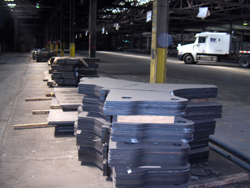 |
| Stacks of treated finished parts |
From PICO's technical perspective, Picoguard 17625 is a technology synthetic oil-free inhibitor that eliminates the need of any emulsified oil, solvents, or other objectionable chemicals and was the answer to Gateway-Joliet's needs. Gateway-Joliet is now planning an in-line process with dry-off capabilities to enhance the film forming characteristics of Picoguard 17625 and thus improve its corrosion protection. The product has some limitations such as it is not meant for outdoor protection nor should coated steel be exposed to direct rain or salt laden atmospheres during shipments or storage. However, Gateway-Joliet's successful application using Picoguard 17625 confirms that oil-based corrosion inhibitors and even other metalworking fluids will be composed of less oil and more synthetic chemistries in the future. The development of fully synthetic industrial fluids that are environmentally friendly is a PICO driving philosophy.
Picoguard 17625's clear water-based solution and oil-free formulation are the keys to its success — particularly its great acceptance by Gateway-Joliet's customers. Although Picoguard 17625's film is very acceptable to many primers, paints, and other coatings without cleaning, PICO strongly recommends that each coating be pre-tested due to the wide variation in formulations and techniques used by the metal-finishing industry.
Gateway-Joliet has greatly improved its blasted and cleaned steel with Picoguard 17625 because of its clean, oil-free, and environmentally friendly composition. Gateway-Joliet's customers are experiencing Picoguard 17625's many benefits such as its total positive acceptability during their various metal-processing steps from welding to finishing, not to mention the rust-free surfaces. Because this oil-free steel coating does not contain any objectionable ingredients, customers will not have to waste treat their effluent nearly as much as they did before. Thus, Gateway-Joliet and their customers have become more "green" with Picoguard 17625. PICO Chemical Corp.,
www.rsleads.com/710tp-151
Help other readers advance their know-how by sending your feedback on this article to
Tooling@ToolingAndProduction.com.