November 2007 Edition
ultra-fast lasers
Fabricators are learning the gains are to the swift
By Thomas Burdel and Pieter Schwarzenbach, PRIMA North America
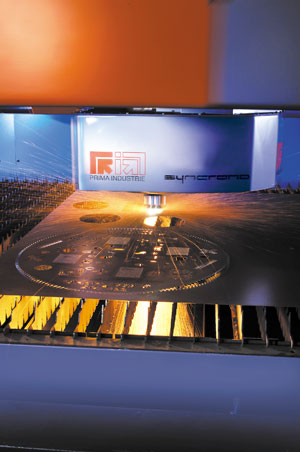 |
| Moving the horizons of laser cutting beyond the threshold of 1,000 holes per minute is PRIMA Industries' Syncrono. |
High-speed cutting has always been a prime concern in manufacturing, especially for fabricators. Their search for higher positioning, cutting, and processing speeds started with the first laser system for sheet metal parts, which was introduced in 1978, based on a turret-punch frame using a sheet dragger and a fixed laser beam delivery system.
The initial process of a laser beam moving around sheet metal to cut a part or hole was a slow method when compared with punching a hole in less than a fraction of a second. Laser-beam divergences had not been mastered, and laser power was only about 500W. However, the quest for higher processing speeds was on, leading to the first flying-optics system in 1979. For approximately 10 years, laser productivity gradually increased until the early 1990s, when flying-optic systems evolved with increased laser power (close to 3,000W) and faster CNCs combined with better drives, allowing more than 5,000ipm positioning speeds.
It seemed by the mid-1990s the physical limit of large-gantry machines handling 5'x10' sheets with tremendous mass and high forces was reached. The introduction of linear drive motor technology changed that by offering speeds over 10,000ipm and high dynamics, allowing the processing of 600 holes per minute in thin sheet metal. This was accomplished by combining positioning speed with new, instant piercing technology and great acceleration forces between 1G and 3Gs. Any higher speed would require extremely heavy, expensive, and non-economical machine frames, as forces increased exponentially with the increase of speed and mass.
Dual-head cutting machines were also introduced in the mid-1990s as a seemingly straightforward solution to double the productivity of a laser-cutting machine. But this solution required two laser resonators, two beam-delivery systems, two Z-axes and cutting heads. Two identical parts were produced simultaneously with those machines, but because of additional costs and other drawbacks, this approach did not succeed.
Real breakthrough
Incremental progress in positioning and cutting speeds from 1997 until 2004 was made, as higher laser power became available and piercing technology became more refined. In 2005, a real breakthrough arrived with the introduction of two additional parallel-kinematic-drive axes on the cutting head, effectively creating two machines in one – a highly dynamic and light cutting head and a machine with a large work volume moving in precise synchronicity. The two "machines" are coordinated by algorithms that automatically control the local axes of the head and main axes of the machine. The local axes perform "micro" movements (holes, corners, small shapes, paths with frequent changes of direction), while the main axes carry out "macro" movements (contours, large shapes, etc.) The "micro" and "macro" movements are carried out simultaneously, like those of a human hand and arm when writing or playing the keyboard. The numerical control, like the human brain, synchronizes them to achieve continuous, smooth, and fast movement. This approach opened up new frontiers and much higher limits in processing speeds.
New synchronized ultra-high-speed laser-cutting systems can be twice as productive as conventional systems. For an approximately 20 percent investment increase, today's manufacturers can have a high-performance laser that will meet all their present requirements and future possibilities.
Two short, linear-driven axes on the cutting head make all small-scale movements (up to 4" in X and Y) for holes and intricate cutouts. With minimal weight and optimized linear drives, accelerations increased up to 6Gs in actual cutting conditions. Previously, high acceleration rates had only been reached in positioning speeds and vibrations had diminished the cutting quality because of heavy masses being moved around.
To augment this level of speed, other machine design features were also implemented such as: the addition of shock compensation to the additional short travel and lightweight X and Y axes for eliminating vibrations transferred to the machine; and proprietary CNC control software. This approach, combined with the revolutionary head design enabling 6G acceleration, more or less doubled productivity compared with conventional machines, reduced power consumption, decreased wear and tear on the machine, and improved cut quality.
Interestingly, with vibration eliminated, two axes simultaneously moving, and increased acceleration, motion is deceiving. For example, some attendees who viewed the new technology in action at a recent Fabtech commented that the cutting head seemed to "float" over the workpiece while cutting up to 1,000 holes per minute.
Cut quality enhanced
It is a well-known fact that with increased cutting speed, the cut quality often deteriorates, leading to rough edges, dross formation, vibrations, and other deviations. Yet the physics of the cutting process are not altered with new, synchronized ultra-high-speed cutting machines, with the cutting speed still depending on the material, thickness, laser power, beam quality, and focal spot size, as well as assist gas type, pressure, and shape of the nozzle. Higher laser power and nitrogen as a cutting gas have extended the limits for good cut quality to 800ipm, especially for thin-gauge sheet metal up to 1/8". The difference is in higher acceleration versus higher cutting speeds, with the CNC reducing the cutting speed below the programmed value to avoid a potential "overshoot" of the cutting process.
The combination of high dynamics and acceleration allows the user to optimize the cutting process, maintaining the programmed cutting speed to a much greater extent. This new synchronized ultra-high-speed cutting not only increases productivity, but also results in better cutting quality because of reduced heat load in corners and small features of complex contours.
Flexibility gains
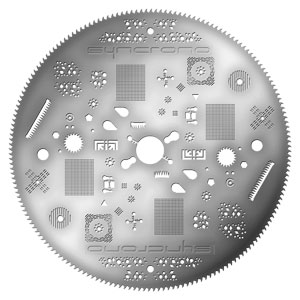 |
| The high productivity of punch presses has been challenged by high-speed laser-cutting machines, which have the advantage of higher flexibility of cutting any hole diameter/shape without the need of tool changes or new tools. |
The high productivity of punch presses has been challenged by high-speed laser-cutting machines, which have the advantage of higher flexibility of cutting any hole diameter/shape without the need of tool changes or new tools.
Lasers feature no limitations of contour complexity, allowing manufacturers to use their utmost creativity for designing better products. With synchronized ultra-high-speed cutting machines the complex contour is easy to process, providing improved parts at a lower cost. The costs are reduced by faster production and fewer steps in the manufacturing process. Examples of increased flexibility include: one single pass for cutting holes, cut outs and contours; easy rounding-off of sharp corners; and no deburring. In addition, slots and tabs for positioning, welding, and assembly improve product accuracy and significantly reduce the need for fixturing.
Fabricators can use synchronized ultra-high-speed machines to their advantage with a large variety of customers whose needs are in the 0.020" to 1" thickness range in mild steel, aluminum, and stainless steel, although the maximum advantage is in the material thickness of 1/8" or less. Piercing of thin material is instantaneous and cutting speeds can go up to 800ipm or more. Cutting speeds and piercing of thicker material are considerably slower from a fraction of a second to several seconds.
An investment in a new laser-cutting system should be researched by finding the optimal ratio of light gauge to thick material, and where the most profit comes from. Synchronized ultra-high-speed machines are faster than turret punch presses and setup times are almost non-existent, making it possible to produce a part in half the time than a conventional laser or punching machine. In turn, the extra production time gained allows the fabricator to take on new jobs and expand business operations in precision sheet metal fabrication markets. Some of these markets include electronic enclosures, appliance parts, lighting and store fixtures, light aircraft parts, air-conditioner parts, and many more. Since these parts can be manufactured almost anywhere and no extra material handling is required to move material on the production floor, the need for larger facilities, tooling, and other hindrances are removed.
New synchronized ultra-high-speed laser-cutting systems can be twice as productive as conventional systems. For an approximately 20 percent investment increase, today's manufacturers can have a high-performance laser that will meet all their present requirements and future possibilities. Most precision sheet metal operations get a wide variety of manufacturing orders. Still, a common mix of light-gauge fabricated parts can be laser cut with increases in productivity of at least 40 percent, making the decision to invest in synchronized ultra-high-speed laser cutting an easier one.
Clear choice
It is no secret that the performance increase of laser-cutting systems will continue to replace more and more conventional machine tools such as punching machines, shears and plasma cutters. Product requirements and material thickness notwithstanding, it is essential to have a synchronized ultra high speed machine. Operations should not hesitate to venture into "ultra speed" for the right applications, especially for demanding markets, because costs for consumables and part production are much lower, while high-volume processing is attained. Plus, the cutting quality with high-acceleration machines is better because of reduced overheating of the material, especially in small features, and production flexibility is even further enhanced with automated material-handling systems. All leading to today's goals of maximum quality and productivity for the utmost in lean manufacturing.
PRIMA North America,
www.rsleads.com/711tp-162